The BOUNCE Approach®
for Foster Carers
A New Understanding
Understanding the child you are building a life with
You said yes to a child you had read about in a few pages of notes, met briefly – if at all – before they moved in, and now share a home, a routine, and a life with.
You know things about this child that were never written down anywhere. You know what their face does in the second before a meltdown starts. You know which days are “off” before anything has even happened. You know that the version of them at the LAC review is not always the version of them at 7am on a school day.
And you also carry things nobody else quite sees. The exhaustion of being endlessly patient with a child who is testing whether you will give up like everyone else did. The strange loneliness of caring a child whose history belongs, in part, to other people. The low hum of always being slightly “on” – aware that how you respond in any moment might end up written into a report.
The BOUNCE Approach® will not take any of that away. But it might help make sense of some of it – and give you a way of understanding your child that does not depend on knowing their full story.
A New Perspective
This is not about "good" or "bad" behaviour. It is about a nervous system that has had to learn to survive.
A child who has experienced separation from birth family, multiple moves, or early neglect or harm has often had to adapt – fast, and young – to a world that did not feel safe or predictable. Those adaptations do not switch off because the child is now somewhere safer. They show up in your home, in your car, at the dinner table, on the way to contact.
The shutdown when a routine changes. The rage that arrives faster than you can blink. The constant low-level vigilance, even when nothing is wrong. The way affection can sometimes tip into pushing you away, hardest, right when things are going well.
None of that is the child being difficult by choice. It is a nervous system doing what it learned to do, in a body that is still catching up to the fact that things might actually be different now.
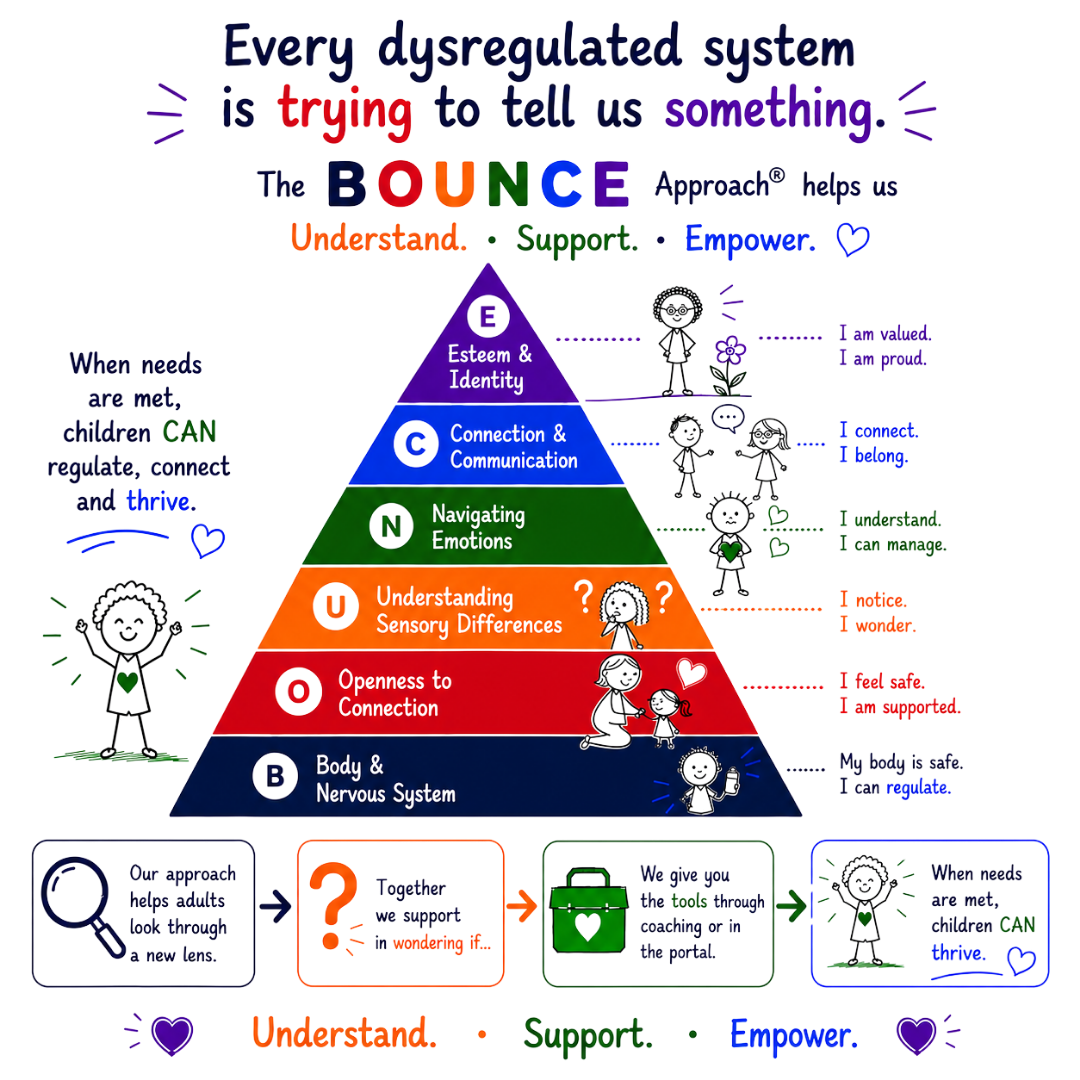
The BOUNCE Approach® helps you see that – and gives you a way of responding that does not just manage the moment, but slowly helps your child’s body and brain learn something new.
Our Approach
Not sure? Find your BOUNCE starting point first.
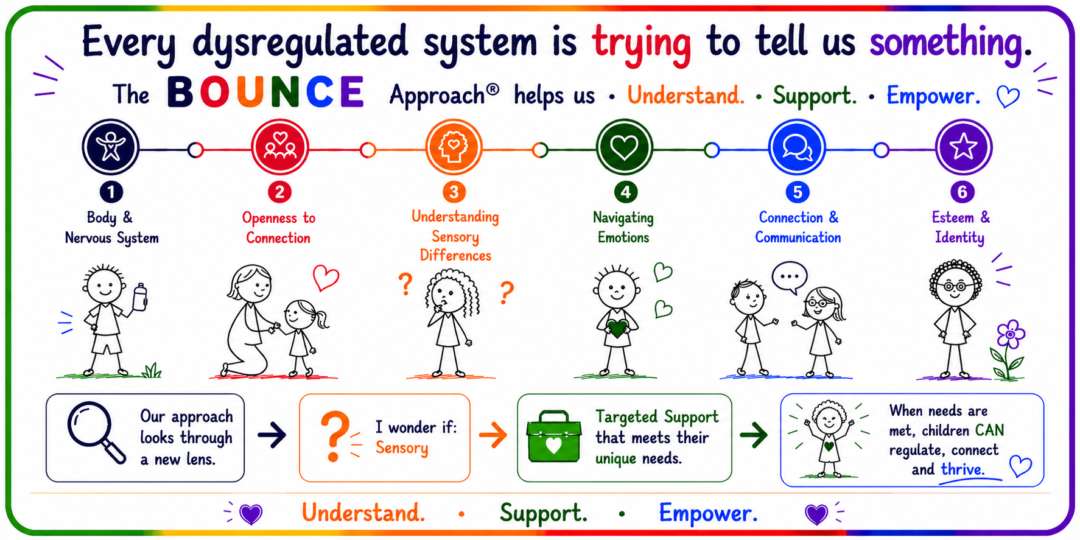
Every child is different. The six BOUNCE pillars help you look beyond behaviour and explore the areas that may be influencing a child’s wellbeing, regulation, relationships, learning, and development.
Select any pillar below to discover what else you can add to your toolkit.
🧠 Body & Nervous System Grounding, regulation & somatic awareness. Show more →
- Grounding Techniques
- Exploring Mindful Awareness Interventions
- Reducing Anxiety through Gut Health
- Somatic Exercises
- Running SEMH Sensory Circuits
- Interoception in the Classroom
🤝 Openness to Connection Trust, attachment & co-regulation. Show more →
👂 Understanding Sensory Sensory processing & awareness. Show more →
💭 Navigating Emotions Emotional expression & regulation. Show more →
- Drawing Feelings Intervention
- Drumming for Regulation
- Emotional Regulation and Bounce
- Executive Functions and Poor Behaviours
- Managing Demand Avoidance
- Creative and Expressive Arts
- Lego Feelings Intervention
- Different Behaviour Between Home and School
- Running a Play-doh Feeling Session
- Exploring NVR in the Home
- Emotionally-Based School Avoidance
- Reducing Anxiety in Children
- Negative Behaviour and Emotional Intelligence
💬 Connection & Communication Communication skills & connection. Show more →
⭐ Esteem & Identity Self-esteem, identity & belonging. Show more →
- A Parts Approach
- Supporting ADHD — The BOUNCE Way
- Being Neurodivergent Affirming
- Supporting Autistic Students in the Classroom
- Supporting Neurodivergent Children at Christmas
- Running a Tree of Life Intervention
- Expanding the Window of Tolerance
- Understanding and Supporting a Child with Tourette Syndrome
- Supporting Students with Executive Function Difficulties
Three ways to go further
Wherever you are starting from - there is a right next step for you
📚
Family Membership
Everything you need to support your child at home.
Show more →
- Over 25 specialist courses
- Learning pathways around the six BOUNCE pillars
- Strategy videos and activities
- Resources and music library
- Live drop-in sessions
- From £12.99/month →
💬
Family Coaching
One-to-one support tailored to your family.
Show more →
- Personal sessions with BOUNCE-trained practitioner
- Tailored to your child and family situation
- Real strategies for everyday moments
- Flexible scheduling around your life
- Discounted rates for members
- Book a session →
🔍
Specialist Directory
Find verified practitioners near you.
Show more →
- Speech and language therapists
- Sleep specialists and occupational therapists
- BOUNCE-trained practitioners
- Search by location and specialism
- Direct contact information and qualifications
- Find a specialist →