BOUNCE Approach®MaskingCPD CertifiedOn-DemandND-Affirming
Different Behaviour Between Home and School
Explore the neuroscience behind why children hold it together at school and fall apart at home — and how professionals and families can work together to reduce triggers and build genuine safety.
When a child appears calm at school and explosive at home, it’s not inconsistency — it’s the nervous system doing exactly what it’s designed to do. Holding it together all day is exhausting work, and home is where the mask comes off. This training explores the neuroscience behind why emotional regulation breaks down over the course of a day, what happens in the brain when a child “flips their lid,” and why the place a child feels safest is often where the biggest reactions happen.
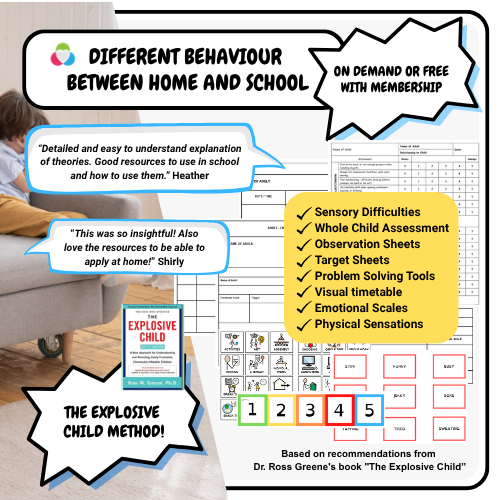
Drawing on the work of Dr Ross Greene and a non-punitive, child-centred approach to dysregulation and unmet needs, this training helps professionals and parents understand what’s really happening underneath — and how to work collaboratively across home and school to reduce triggers, build consistency, and create a greater sense of safety for the child. Suitable for school staff, SENCOs, pastoral leads, therapists, and families.
Objectives
Learning Objectives
By the end of this training, children will be able to understand:
1
Why I show different emotions at home and at school
Understand why it is completely normal to feel and behave differently in different places — and why the home and school versions of me are both real, both valid, and both telling the people around me something important.
2
Why I can struggle to keep things together for a whole day
Understand how the demands of a school day gradually fill up my nervous system — and why by the end of the day there is often very little capacity left to hold it together, no matter how hard I try.
3
What is happening inside my brain when I flip my lid at home
Understand in simple, clear terms what is happening in my brain during those big moments at home — and why it is not about being naughty or difficult, but about a nervous system that has run out of room.
4
That sometimes my brain is being triggered and I feel unsafe
Begin to understand that when things feel overwhelming or frightening, my brain is detecting danger — even when there isn’t any — and that this is something that happens to my body, not a choice I am making.
5
How to help me so I don’t feel so wobbly and full of adrenaline
Discover what actually helps when my nervous system is activated — and begin to build a picture of the things, people, and conditions that help me feel safer, calmer, and more settled inside.
6
How to work together — because safe people are consistent and act the same way
Understand that feeling safe with the adults around me depends on them being consistent, predictable, and the same across home and school — and that working together as a team is what makes the biggest difference for me.