BOUNCE Approach®RegulationCPD CertifiedOn-DemandND-Affirming
Understanding and Applying Grounding Techniques
Learn how to use movement, rhythm, and sensory awareness to bring children back to safety when they’ve moved into survival mode — so the body feels calm enough to think again.
When children are overwhelmed, their bodies move into survival mode — fight, flight, freeze, or shut down. Words and reasoning don’t land until the body feels safe again. Grounding techniques work body-first, using movement, rhythm, and sensory awareness to restore calm and connection before anything else becomes possible.
This training helps you recognise what dysregulation looks and feels like, match what you’re seeing to the child’s underlying nervous system state, and apply grounding approaches that genuinely restore focus and readiness to learn. You’ll also explore how your own calm, regulated presence is itself one of the most powerful grounding tools available.
Used and adapted by Whitehall Academy with significant results, this training shifts the focus from controlling behaviour to helping children feel safe enough to re-engage — making every interaction an opportunity to rebuild trust. Suitable for any adult working with children who experience emotional overwhelm or dysregulation.
Objectives
Learning Objectives
By the end of this training, you will be able to:
1
Understand our states of emotion through a Polyvagal lens
Explore how Polyvagal Theory explains the different states of emotional activation — and understand how the nervous system moves between safety, mobilisation, and shutdown in response to perceived threat.
2
Understand these emotional states in the brain
Explore what happens in the brain during different emotional states — and understand the role of conscious and unconscious processing in how children experience and express emotion.
3
Understand how grounding moves us through emotional states
Explain how grounding techniques interrupt the stress response and support the nervous system in returning to a state of safety — and why this must happen before any reasoning, reflection, or learning is possible.
4
Review the adrenaline curve and why it matters
Understand how adrenaline rises and falls during activation — and why timing your response to a child’s emotional state is as important as the response itself.
5
Explore each grounding technique linked to our senses
Discover a range of sensory-anchored grounding techniques — and understand how each one works with the nervous system to bring a child back into the present moment and out of overwhelm.
6
Understand the importance of co-regulation
Recognise why the adult’s own regulated state is the most powerful grounding tool available — and how your nervous system directly shapes whether a child can access calm in any given moment.
7
Use grounding techniques on a day-to-day basis
Leave with the confidence and practical knowledge to embed grounding techniques into daily routines — so regulation support becomes a consistent, low-demand part of every child’s day.
Resources
What’s Included
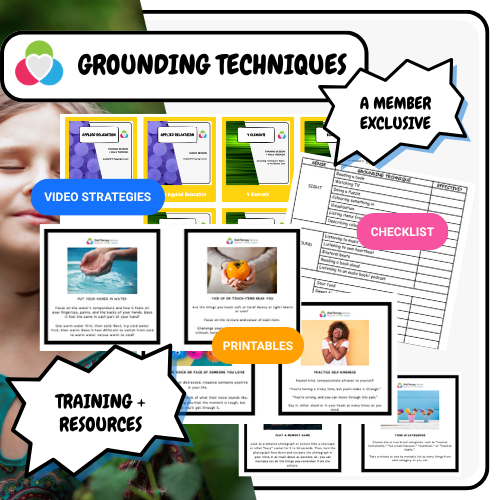
Two practical resources to support you in applying grounding techniques with confidence day to day.
1
Grounding Techniques Checklist
A quick-reference checklist of grounding techniques to keep to hand — so you can select and apply the right approach for the child and the moment without having to think from scratch under pressure.
2
Grounding Techniques Resource Pack
A comprehensive pack covering self-soothing, physical, and visual grounding strategies — ready to use directly with children or adapt for individual sensory profiles and regulation needs.