Snapshots
Welcome to Snapshots
The 2-minute Tool
You already know which children you’re worried about. The challenge is knowing what to do next — and being able to show it’s working.
Most assessment tools take 20+ minutes, require trained practitioners, cost thousands, and stop at identification. You get a profile but no plan. And because they take so long, most settings only run them at the start and end of term — by the time you know the provision isn’t working, the term is already over.
Snapshots works differently. Rate any child in 2 minutes. Get an instant tiered support plan. Re-run mid-term to evidence impact while there’s still time to adjust.
A clear picture of need, a plan any staff member can deliver, and the data to prove it worked.
Instant tiered support plan
Mid-term review
Any staff member can deliver
Evidences impact in time to act
Closes the loop
What this Means in Practice
A clear risk level in minutes
Rate any child across key social and emotional domains. Get an instant, consistent result — the same reading every time, regardless of who runs it.
An instant support plan
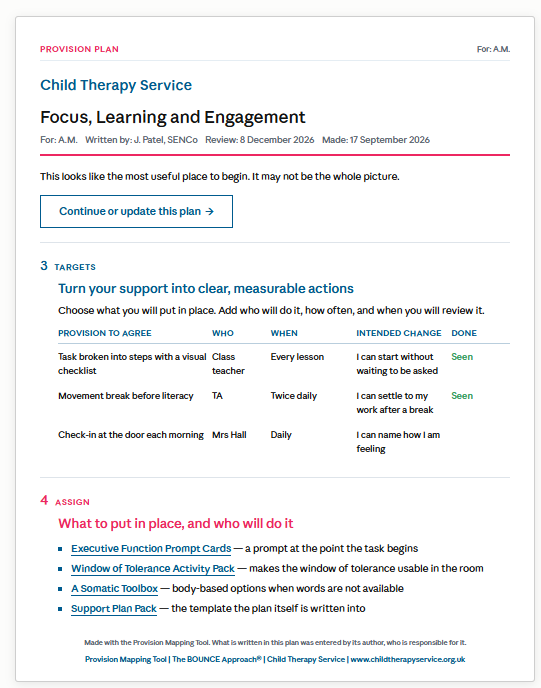
Every flagged area automatically generates a tiered support plan — Universal, Targeted, and Individual — ready to print and hand to staff.
Staff checklists
Each support plan includes a printable implementation checklist — clear actions a staff member can pick up and use straight away, no training required.
Built-in evidence of impact
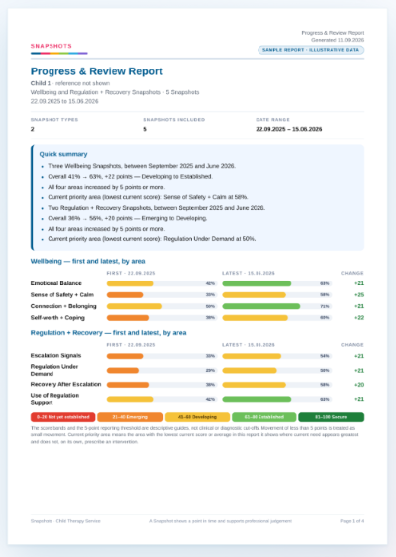
Re-run the Snapshot at 4–6 weeks to measure what’s changed. Track progress over time and build a clear record of need identified and action taken.
Pricing
Snapshots is included with every professional Learning Portal membership
The Learning Portal gives you the provision — activities, strategies, training, and resources. Snapshots gives you the system to measure whether it’s working, mid-term, not end-of-term. Together: a complete assess–plan–review cycle.

Trusted Service
Supporting children across home, school and services — every day
★ Trusted by Local Authorities
Approved supplier to multiple UK local authorities, MATs, and organisations across England, Scotland, Wales, and Northern Ireland.
Including Lancashire, Leeds, South Ayrshire, Hampshire, and Bridgend
Already meeting standards for safeguarding, quality, and procurement – so you can move forward with confidence.
Frequently Asked Questions
How long does a Snapshot actually take to complete?
Two minutes. There are no lengthy questionnaires or complex assessment forms – just a quick, structured rating across key social and emotional domains that generates an instant result. It’s designed to fit into the reality of a busy school, therapeutic or care setting, not add to it.
What Snapshots are available?
There are five evidence-based Snapshots, each designed to identify risk and generate a support plan across a specific area of social and emotional need:
Wellbeing — identifies children who may be struggling with their overall emotional health, sense of safety, and ability to cope with the demands of daily life.
Transition — flags children who are at risk during key points of change, whether that’s moving between settings, year groups, or significant life events that can destabilise even the most resilient child.
Regulation — identifies children who are struggling to manage their emotions, behaviour, and sensory responses — and who need targeted support before difficulties escalate.
Social Skills — highlights children who are finding relationships, communication, and social connection difficult, giving staff a clear picture of need and a structured pathway to support.
Engagement — identifies children who are disengaged from learning, whether through anxiety, unmet emotional need, or barriers that conventional approaches haven’t yet reached.
Every Snapshot is evidence-based, takes just two minutes to complete, and works alongside your professional judgement to give you a consistent, defensible risk level and an immediate, actionable support plan — with provision linked directly to the Learning Portal for members with full access.
Who can run a Snapshot?
Any professional – no specialist training required. Snapshots has been built to deliver a consistent result regardless of who runs it, which means a class teacher, teaching assistant, family support worker, or care practitioner can all use it with confidence and get the same reliable reading.
Importantly, Snapshots is designed to work alongside your professional judgement, not replace it. It gives you a clear, structured framework to articulate and evidence what you are already observing – turning professional insight into a consistent, defensible record that every member of your team can contribute to equally. The result is a shared picture of need that is both faster to build and easier to act on.
Does Snapshots hold or store personal data about children?
No. Snapshots does not collect, store, or retain any personal data about the children you assess.
No names are entered, no identifying information is recorded, and nothing is saved to the system. Each Snapshot is run in the moment, generating an instant risk level and support plan without creating any kind of personal profile or data record for the child.
This makes Snapshots straightforward to use within your existing GDPR and data protection policies – with no additional compliance burden for your setting, no information governance approvals required, and no concerns about where sensitive data is being held or who has access to it.
For schools, NHS services, care homes, and therapy practices where data protection is rightly taken seriously, this is a significant practical advantage – powerful, evidence-based assessment with none of the data risk.
How is Snapshots different from Boxall, Thrive, and other assessment tools?
Most established SEMH assessment tools were built for a different era of education – one where the priority was producing a detailed report at the end of a term rather than identifying risk and responding to it in real time.
Boxall Profiles are lengthy, time-consuming, and typically completed termly. By the time the results are in, weeks of opportunity to intervene have already passed.
Thrive assessments are similarly detailed and require trained practitioners to administer them – creating a bottleneck that leaves the majority of staff without the tools to act.
The current climate demands something fundamentally different. The government’s SEND and AP Improvement Plan, combined with the evolving Ofsted inspection framework, is asking schools and settings to do something previous approaches were never designed for – to evidence not just what provision was put in place, but whether it worked, for which children, and how you know.
Inspectors are no longer satisfied with a file of referrals and intervention records. They want to see patterns of emerging risk identified early, provision matched to need consistently, and clear evidence of impact over time.
A termly Boxall Profile cannot give you that. A lengthy Thrive assessment cannot give you that. A report that tells you what was done but not whether it made a difference cannot give you that.
Snapshots was built specifically for this moment. Two minutes to run. An instant risk level. A support plan in your hands the same day. And a repeatable review cycle at four to six weeks that answers the one question Ofsted — and every child in your care — actually needs answered:
Is the provision I have in place today working? Yes or no.
Not at the end of term. Not after a lengthy assessment process. Right now, when it still matters enough to change something.
For schools, NHS services, care homes, and therapy practices operating in an environment where evidencing impact is no longer optional, Snapshots is the only tool built from the ground up to give you that answer — consistently, quickly, and without adding to an already unsustainable workload.
What does the support plan actually look like?
Every flagged area automatically generates a structured, editable support plan across three tiers – Universal, Targeted, and Individual – so the right level of support is matched to the right level of need straight away. Each plan includes a printable implementation checklist with clear, specific actions that any staff member can pick up and use immediately.
For members with access to the full Learning Portal, the support plan goes significantly further. Rather than offering generic activity ideas, every recommended strategy links directly to evidence-based provision inside the portal – CPD courses that build staff knowledge and confidence in that specific area, printable resources ready to use with children straight away, and structured programmes that give your team a clear, consistent pathway to follow. Every recommendation is actionable, evidenced, and already waiting for you the moment you log in.
This is the difference between a support plan that tells you what to do and one that shows you exactly how to do it – with everything you need already in place.

How do we use Snapshots to evidence impact?
Simply re-run the Snapshot at two to six weeks.
The repeat process gives you a direct comparison – a clear, visual record of what has changed, what still needs attention, and what your provision has achieved.
Over time this builds an evidenced history of need identified and action taken that stands up to scrutiny from senior leaders, Ofsted, commissioners, and parents alike.
We already have Thrive Practitioners and ELSAs — do we still need Snapshots?
Yes — and this is where Snapshots genuinely fills a gap that most settings don’t realise they have. Your Thrive Practitioners and ELSAs deliver excellent targeted support, but Snapshots tells you whether that support is working —-consistently, quickly, and in a format you can share with confidence. It’s the evidence layer that sits above your existing provision, turning good practice into measurable, defensible outcomes.
Can we use Snapshots as a Local Authority to evidence improvement?
Yes — as part of a wider evidence base.
Snapshots are not diagnostic or standardised assessments. They provide a consistent, point-in-time indicator of a child’s current needs, which can be reviewed over time.
For Local Authorities, this means they can be used to:
- Support early identification and a graduated response
- Create a shared, consistent baseline across settings
- Show that needs are being identified, supported and reviewed
- Indicate direction of change over time
They are most effective when used alongside existing data and professional judgement, helping to evidence:
What was identified → what was done → whether things are changing
We support children at risk of exclusion, persistent absence, or not in education — how can Snapshots help?
Snapshots provide a simple, consistent way to understand need at the point of contact, particularly for children who are not currently accessing education or are at risk of disengaging.
They are not diagnostic or clinical tools. Instead, they help practitioners quickly build a shared picture of what is currently getting in the way — across areas such as wellbeing, regulation, engagement, social connection, and transition.
For teams working across an authority, this means Snapshots can be used to:
- Create a clear starting point when a child is first seen
- Support consistent thinking across different practitioners and services
- Identify whether difficulties are more likely linked to:
- regulation
- emotional wellbeing
- social barriers
- engagement with learning
- challenges around change or transition
- Guide early, proportionate support, rather than waiting for escalation
Because Snapshots can be repeated, they also support:
- Review conversations — what’s changed since support was put in place
- Tracking whether a child is becoming more able to:
- engage
- regulate
- attend
- Building a clearer picture over time, especially where progress may be gradual
They are particularly useful in cases where:
- a child is not attending school
- engagement is inconsistent or fragile
- multiple services are involved
- there is no single, shared understanding of need
Snapshots do not replace professional judgement or existing systems. They sit alongside them, helping teams answer:
“What is most likely getting in the way right now — and is what we’re doing helping?”
We already use assessment tools — can Snapshots be used alongside them?
Yes — and that’s exactly how they are designed to be used.
Snapshots do not replace existing assessments or frameworks. They provide a quick, consistent layer of insight that can sit alongside what you already use.
How they fit in
Snapshots can be used:
- At the start of support to create a clear baseline
- Alongside existing assessments to add a current, observable view
- As part of review points to track change over time
They work particularly well where existing tools are:
- more detailed
- used less frequently
- focused on thresholds rather than day-to-day functioning
What they add
Each Snapshot generates:
- A single overall score, with domain-level breakdown
- A clear risk category (At Risk / Potential Risk / No Risk)
- An editable support plan (Word document)
- Direct links to practical provision and downloadable pdf resources that can be used immediately
This allows practitioners to move quickly from:
understanding → planning → action
without adding complexity.
Using the data
The output is intentionally simple and easy to integrate.
- Record a baseline score
- Re-run at a review point (e.g. mid-term)
- Re-run again to monitor longer-term change
For example:
Timepoint | Score | What this shows |
Baseline | 42 | Higher level of need |
Review 1 | 55 | Improving |
Review 2 | 75 | Within typical range |
- Lower scores indicate higher levels of need
- Higher scores indicate reduced risk and greater stability
As scores increase over time, this shows progress and reduced vulnerability.
This can be recorded in:
- existing case management systems
- or a simple spreadsheet
You can also calculate percentage of change between timepoints if required for reporting.