
SEMH Needs Are Rising
Using The BOUNCE Approach®
What’s happening
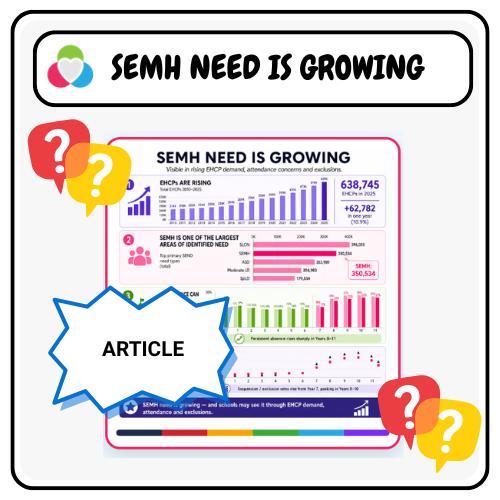
- In 2025, over 350,000 children in England are identified with Social, Emotional and Mental Health (SEMH) needs — and numbers are still climbing.
- Behind the statistics are children struggling with anxiety, aggression, shutdowns, and school avoidance.
- SEMH rarely stands alone. It is often a secondary need for autistic children, those with communication differences, or specific learning needs.
- Energy battery impact: ongoing emotional distress leaves children drained, dysregulated, and misunderstood.
The BOUNCE Approach®
🖤 B — Body and Nervous System (Inside Tool)
- View SEMH as a nervous system signal, not a behaviour problem.
- Teach simple regulation strategies (breathing, rhythm, movement) that can be used daily.
❤️ O — Openness to Connection and Attachment (In-Between Tool)
- Meet the child with compassion, not control.
- Build relational safety so they feel seen and supported.
🧡 U — Understanding Sensory Differences (Outside Tool)
- Notice how sensory and social overwhelm can escalate into behavioural labels.
- Provide proactive supports like quiet spaces, fidgets, or adapted transitions.
💚 N — Navigating Emotions (Inside Tool)
- Support emotional literacy through art, story, and play-based tools.
- Help children notice early signs of dysregulation before they hit crisis.
💙 C — Connection to Self and Others (In-Between Tool)
- Encourage collaboration between home, school, and professionals.
- Use peer and adult modelling to show healthy ways of expressing needs.
💜 E — Esteem and Identity (Inside Tool)
- Affirm that SEMH is not “naughtiness” — it’s a signal of unmet need.
- Celebrate children’s resilience and unique ways of coping, while building new supports.
Adult Focus:
- Early intervention is key — don’t wait for diagnoses or labels before offering support.
- Shift from asking “How do I stop this behaviour?” to “What’s underneath it?”
- Prevention is possible when families, schools, and professionals act early and consistently.
Next Steps
- Explore further learning:
- De-escalation through Co-Regulation — reducing conflict and supporting emotional safety.
- Play-Doh Feelings and Sand Tray Interventions — creative tools for safe emotional expression.
- Window of Tolerance — understanding stress responses and how to respond effectively.
- SEMH-informed LEGO-based Therapy — playful, structured interventions for regulation.
- Join the Learning Portal: Access 80+ ready-to-use interventions, INSET training packs, and creative early intervention tools for families, educators, and professionals.
👉 Become a member today: www.childtherapyservice.org.uk/membership
Final word
SEMH isn’t a behaviour problem — it’s a nervous system signal. When we respond with compassion instead of control, we create conditions for inclusion, connection, and long-term wellbeing.