BOUNCE Learning JourneysRegulation before reasoning. Safety before learning.
Thirty ready-to-deliver sessions that build from the body up — nervous system and safety first, then sensory needs, emotions, communication and identity.
- 30 Learning Journeys
- Interactive Studio tools
- Ready to deliver
- One clear developmental sequence
Ready-to-deliver sessions
BOUNCE pillars
Sessions a half-term
Months of planning
A full year of SEMH and PSHE, built on The BOUNCE Approach®Body and nervous system first · identity last · one pillar per half-term
You know these children and young people. They may know the lesson — but still struggle to use it when it matters.
Knows the emotion words.
Can name every face on the feelings chart, but still cannot recognise what is happening in their own body.
Knows the right answer.
Can tell you what they should do — then cannot access it twenty minutes later when something actually happens.
Too dysregulated to learn.
When a child is already in fight, flight, freeze or shutdown, reasoning and discussion may simply be too much.
The activity becomes the barrier.
If the route in is writing, talking or sitting still, some children are working harder to access the lesson than to learn from it.
Sensory needs are shaping the day.
Noise, movement, touch, hunger, tiredness or overload may be affecting everything — yet never become part of the conversation.
Learns the vocabulary, not themselves.
They finish knowing the terminology, but with little more understanding of their own body, patterns, needs or ways to respond.
BOUNCE starts earlier.
Before asking a child to manage emotions, we help them notice their body, understand safety and regulation, and recognise what affects their capacity.
Then we build from there.
The six foundations. Built from the bottom up.
Each pillar is explored over one half-term, five sessions at a time. Start with the body and the nervous system, then build on it.
Look inside before you decide.
See the course, the sessions and the Studio tools for yourself.
Included with the curriculum
A short course on delivering them
Why the order matters, how the resources work together, how to adapt a session and how to recognise meaningful progress. Free with your licence, about an hour.
See what the course covers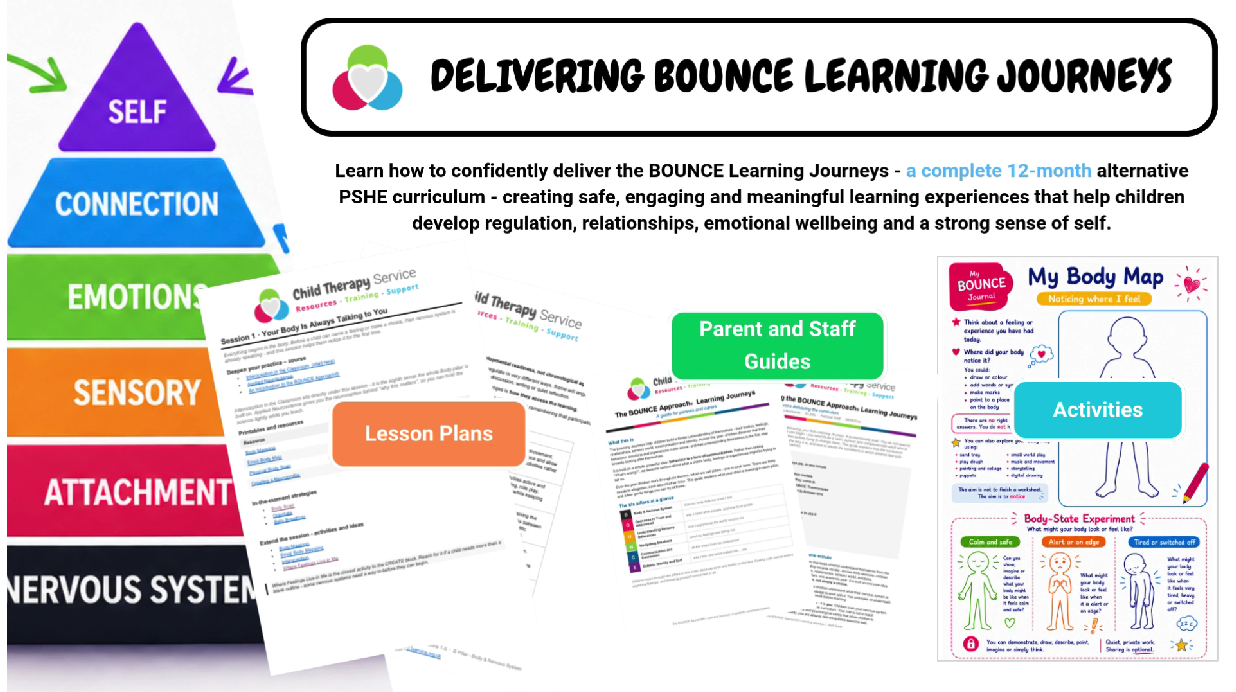
The demo is a working copy of the Learning Portal. No account needed, nothing to install.
The curriculum on its own, or everything connected.
A licence gives you the curriculum and the tools to deliver it. Membership adds the assessment, the training and the rest of the portal.
Curriculum only
Learning Journeys licence
£99a year
Additional licences £20 a year each
- 30 Learning Journeys across six terms
- Every Professional Studio tool, for individuals, groups and classes
- Unlimited use for each licence holder for 12 months
The Snapshots, the CPD courses and the resource library are not included.
Choose your licencesEverything connected
Professional membership
£319a year
or £39.99 a month
- The Learning Journeys and the Studio tools in full
- All five BOUNCE Snapshots, with the entry to exit Progress Overview
- 55+ CPD courses and the resource library
- Live drop-ins with the CTS team
Whole-team access from 3 to 50 staff. Invoicing and purchase orders welcome, with a £25 administration charge.
Join the Learning PortalJust want the tools? The Professional Studio on its own is from £49 a year
A full year of SEMH and PSHE planning. One simple licence.
How many people need access?
Each licence is for one named user with their own login.
Choose a number above to see your price.
£99 a year for the first licence, then £20 a year for each additional licence.
Due today
£0
Renews at £0 a year
Prefer to pay by invoice or purchase order? Invoices include a £25 administration charge.
What you get
- A full year of SEMH and PSHE planning
- 30 structured Learning Journeys across six terms
- Every Professional Studio tool, for individuals, groups and classes
- Works on a laptop, tablet or interactive whiteboard
- Unlimited use for each licence holder for 12 months
After checkout
- Tell us who needs access. You will be guided to a form where you can add the name and email address of each licence holder.
- We set up their access. Each person receives their own login, with email instructions to get started.
- Download your invoice. A copy is available from your account.
Ask for an invoice
Your order has been added to the form below. Add your details and we will send your invoice, then set up each licence holder once it is paid.