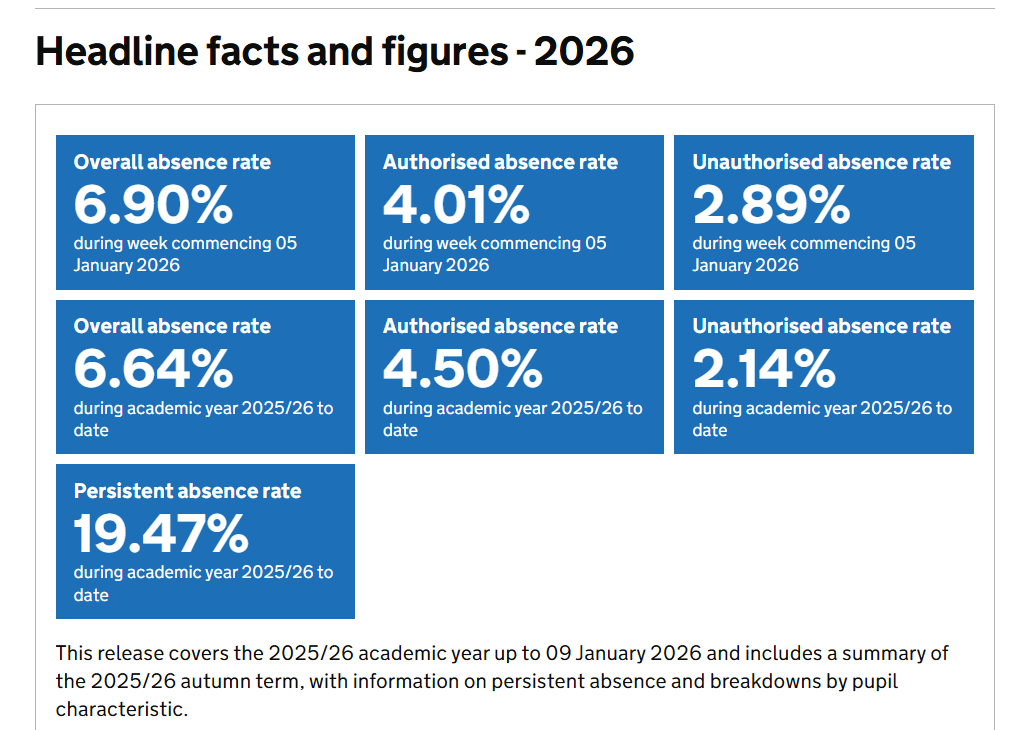
The latest attendance data for 2025/26 is clear and uncomfortable:
- Persistent absence sits at 19.47% — nearly one in five pupils
- Absence remains highest in special schools
- Unauthorised absence is rising, particularly in secondary settings
This is not a short-term fluctuation.
It is a system-level signal.
Children are not simply “choosing not to attend”.
Many are reaching a point where school feels too much for their nervous system to manage.
💭 Why attendance has become a wellbeing issue — not just an attendance one
Across schools, we are seeing the same patterns:
- Children struggling with anxiety, overwhelm, shutdown, or distress
- Increased Emotionally Based School Avoidance (EBSA)
- Rising sensory, emotional, and relational load
- Families stuck between attendance pressure and a child who is not coping
When attendance drops at this scale, it is no longer about routines or motivation.
It is about capacity, safety, and regulation.
🚦The problem with traditional attendance responses
Most attendance systems are built around:
- Monitoring and escalation
- Sanctions or incentives
- Attendance plans without emotional or sensory support
- Referral once absence is already entrenched
These approaches assume children are able to attend but unwilling.
For many children, the reality is the opposite:
They are willing — but not resourced.
Pressure increases stress.
Stress deepens avoidance.
Absence becomes harder to reverse.
📊 What the data is really asking schools to do
The current attendance picture tells us schools need to:
- Understand absence as communication, not non-compliance
- Identify distress before it becomes persistent absence
- Support regulation, not just attendance targets
- Equip all staff — not just specialists — with practical tools
Attendance improves when children feel:
- Safe in their bodies
- Understood by adults
- Supported consistently across the day
- Able to recover from stress, not just endure it
This requires a whole-setting approach, not isolated fixes.
🧩 The gap schools are facing
Leaders regularly tell us:
- “Staff know attendance links to wellbeing, but don’t know what to do.”
- “Pastoral teams are overwhelmed and firefighting.”
- “Support varies depending on which adult a child sees.”
- “We’re expected to evidence impact, but provision feels scattered.”
Attendance is now intersecting with:
- SEMH
- sensory needs
- trauma
- transitions
- relationships
- identity and belonging
Yet many schools are trying to respond without a shared framework or toolkit.
🌱 Why the Learning Portal exists
The Child Therapy Service Learning Portal was created to support schools right here.
It gives settings:
- A clear, regulation-first framework (BOUNCE®)
- Shared language and understanding across staff
- Practical strategies that work in real school environments
- Tools that support children before attendance breaks down
Not as a bolt-on.
Not as another initiative.
But as infrastructure.
🛠️ How the Learning Portal supports attendance in practice
1. It helps staff understand why attendance is hard
Staff learn to recognise:
- Nervous system overload
- Cumulative stress
- Sensory fatigue
- Anxiety-driven avoidance
- Shutdown and withdrawal
This reduces misinterpretation — and prevents escalation.
2. It provides practical, ready-to-use strategies
The Portal includes:
- DBT regulation and grounding activities for arrivals and transitions
- Sensory and somatic tools to reduce school-based stress
- EBSA-informed approaches
- Emotional regulation resources that don’t rely on verbal processing
These strategies support return, recovery, and consistency — not just attendance figures.
3. It creates consistency across the whole setting
Because all staff access the same framework:
- Children experience predictable responses
- Support doesn’t depend on individual confidence
- Approaches remain consistent despite staff turnover
Consistency is one of the strongest protective factors for attendance.
4. It supports evidence, inspection, and accountability
Schools gain access to:
- Assessment trackers
- Provision planners
- EHCP-linked outcomes
- Measurable impact tools
So attendance work is visible, defensible, and inspection-ready.
🏫 Attendance improves when children feel safe enough to attend
With persistent absence approaching 20%, the question is no longer:
“How do we get children back into school?”
It is:
“How do we make school safer, more predictable, and more tolerable for children who are struggling?”
Schools that embed regulation-first, trauma-aware, neuro-affirming practice are seeing:
- Improved engagement
- Reduced escalation to EBSA
- Stronger home–school trust
- More sustainable attendance over time
✨ A practical next step
The Learning Portal keeps training, tools, and support in-house, affordable, and accessible to all staff — not just specialists.
Because attendance does not improve through pressure.
It improves when:
- adults understand what’s happening beneath the surface
- children are supported before crisis
- systems adapt — not just expectations
👉 Explore the Learning Portal
Support attendance by strengthening regulation, consistency, and emotional safety across your whole setting.
For families, professionals, and teams & settings.