When a child shuts down, lashes out, refuses to move, or melts into the floor, our instinct is often to ask:
“Why are they doing this?”
We look for a reason. A consequence. A strategy.
But what if we started somewhere else?
What if the behaviour wasn’t the problem at all?
The nervous system speaks first
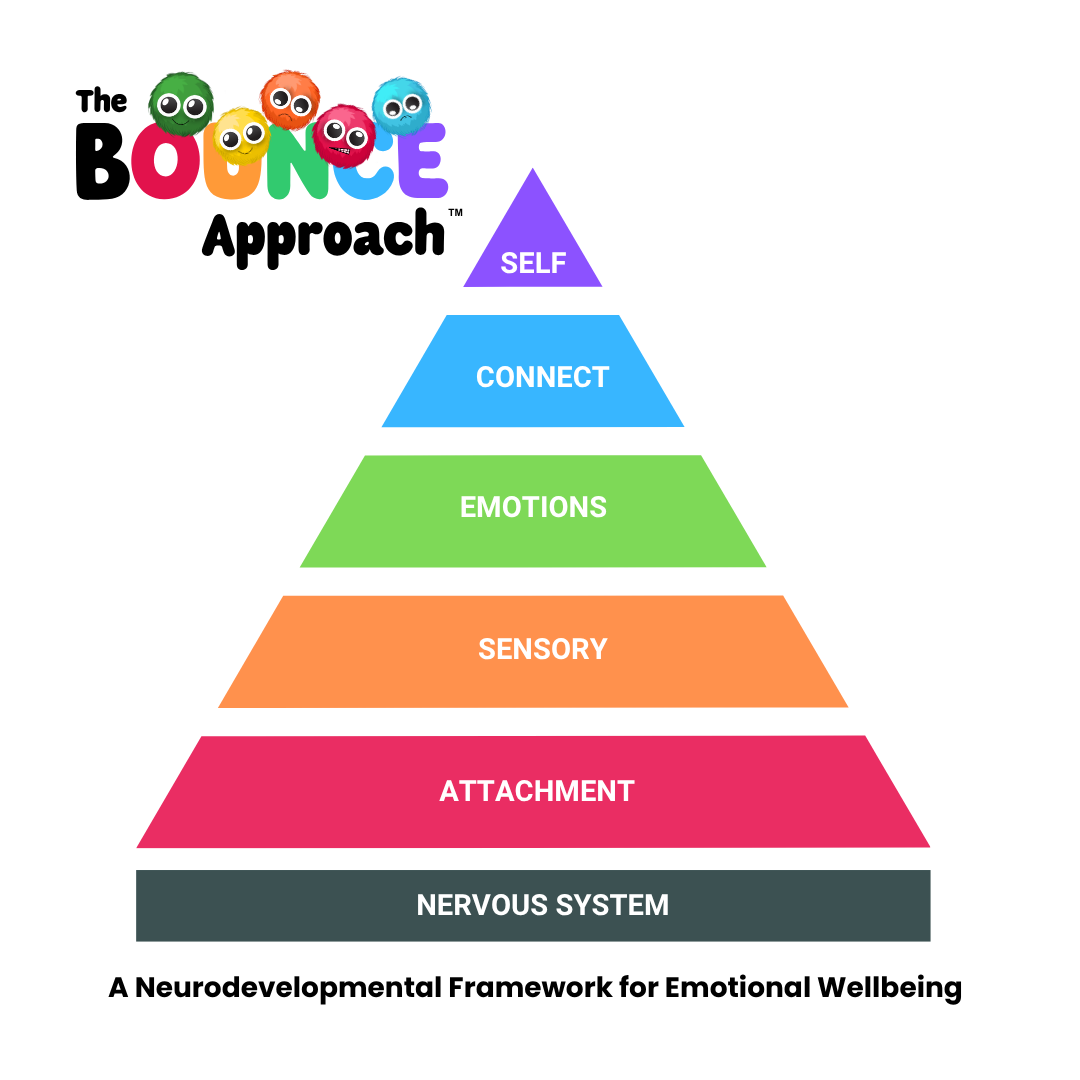
The first pillar of the BOUNCE Approach® is Body & Nervous System because everything else depends on it.
Before children can learn.
Before they can regulate emotions.
Before they can build relationships.
Before they can communicate what they need.
Their body has to feel safe.
Not safe as an idea. Safe as a felt experience.
Modern neuroscience shows us that when the nervous system detects danger, the brain automatically shifts into survival mode. A child may:
FightFleeFreezeShut downBecome highly controllingRefuse demandsWithdraw from others
These responses are not choices.
They are protective nervous system responses.
When this happens, reasoning, explaining, consequences, and problem-solving become much harder for the child to access.
Behaviour is information
The BOUNCE Approach® views behaviour differently.
Instead of asking
“How do I stop this behaviour?”
We begin to ask
“What is this behaviour telling me?”
A child throwing a chair
may be overwhelmed.
A child refusing work
may be anxious.
A child hiding under a table
may feel unsafe.
A child who appears defiant
may actually be protecting themselves from something that feels too much.
The behaviour is visible.
The nervous system underneath it often isn’t.
What does felt safety look like?
Felt safety is not the same as being told you’re safe. Many children can hear:
“You’re fine.”
while every part of their body is telling them they are not.
Felt safety develops through experiences such as:
Predictable routines
Trusted relationships
Calm adult responses
Clear boundaries
Sensory comfort
Being understood rather than judged
Having some choice and control
Over time, these experiences teach the nervous system:
“I can cope.”
“I belong here.”
“I am safe enough.”
Children borrow regulation
One of the most important ideas within the BOUNCE Approach® is that children often borrow regulation before they can create it themselves.
This means the adult matters.
A regulated adult nervous system can help settle a dysregulated child nervous system.
That doesn’t mean being perfectly calm all the time. It means noticing.
The child’s state
Your own state
What the environment might be communicating
Sometimes the most powerful intervention is not what we say.
It’s how we show up.
A different question
The next time behaviour escalates, try pausing before responding.
Instead of asking
“How do I stop this?”
Ask
“Does this child’s nervous system feel safe right now?”
That single question often changes everything. Because when we understand the nervous system first, behaviour begins to make sense. And when behaviour makes sense, support becomes more effective.
One thing to try today
Select one child you support.
The next time they appear dysregulated, spend 30 seconds observing before intervening.
Notice:
Their body postureTheir breathingTheir movementTheir voiceThe environment around them
Ask yourself:
“What might their nervous system be communicating right now?”
Sometimes understanding begins with noticing.
Explore further
The BOUNCE Approach® is a whole-child framework that helps us understand what may be sitting beneath behaviour and where support may be needed most.
Have a good look around the demo. No account needed.