The Difference: From Access to Implementation
Most platforms give you content.
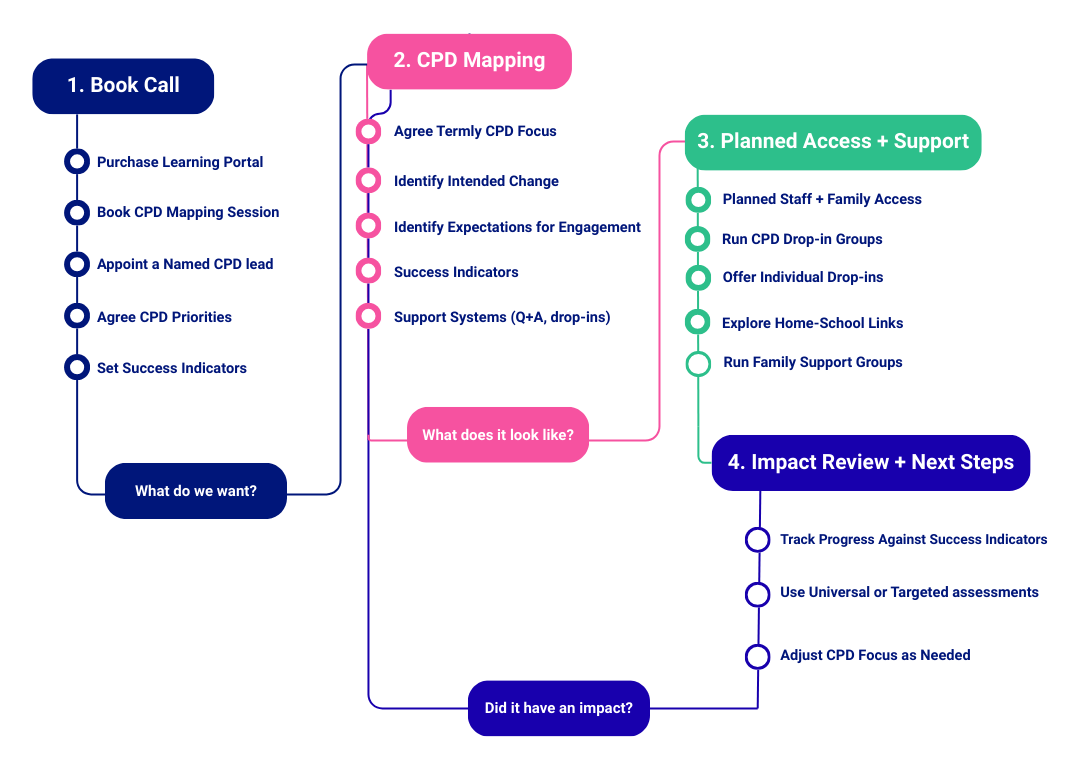
We built the Roadmap to make sure Teams and Local Authorities get change in practice.
It turns the Learning Portal into a planned, supported CPD system — not just a bank of resources.
Because access alone doesn’t create consistency.
Structure does.
What the Roadmap Does
Instead of leaving staff to “dip in,” the Roadmap helps you:
- Set a clear CPD focus (what actually needs to change)
- Define what success looks like in real terms
- Build shared language across staff
- Plan how support will be implemented
- Review what’s working — and what’s not
This is how you move from:
good intentions → consistent practice → visible impact
The CPD Mapping Call
Every team leader can book a CPD Mapping Call.
This is where we turn your context into a plan.
Together, we:
- Clarify your priority (e.g. dysregulation, EBSA, communication)
- Agree what success looks like in your setting
- Identify the change you want to see in staff practice
- Set realistic expectations for engagement
- Map out support, check-ins, and review points
You don’t try to do everything.
You focus on what matters — and protect capacity.
What This Looks Like in Practice
A typical starting point:
A school has committed staff — but inconsistent responses to dysregulation.
Confidence varies. Interventions exist, but aren’t embedded.
This is where most teams begin.
Step 1: Focus
The school identifies a clear priority:
Building staff confidence to respond to dysregulation using regulation-first approaches
They:
- Appoint a CPD lead
- Set a termly focus
- Agree simple success indicators (confidence, consistency, calmer transitions)
- Choose a manageable structure (e.g. weekly short CPD sessions)
- Decide what won’t be a focus
Step 2: Build Confidence
Using short, practical Learning Portal content, staff begin applying strategies to real situations.
Over time, they develop confidence in:
- Regulation-first responses
- Talking about dysregulation using shared language
- Delivering interventions (e.g. LEGO® Therapy) consistently
What was uncertain becomes routine.
Step 3: Align Practice
Instead of adding more initiatives, the school aligns what already exists.
- Sensory circuits become part of daily classroom routines
- Regulation strategies are used consistently across staff
- Pupil support is no longer dependent on individual adults
Consistency replaces fragmentation.
Step 4: Extend Impact
Targeted groups (e.g. nurture) begin structured emotional work.
Children start to:
- Use emotional language
- Request support earlier
- Regulate with less adult input
The impact transfers back into the classroom.
Step 5: Ongoing Support
Staff don’t work this out alone.
They access:
- Live drop-ins
- Ongoing CPD
- Space to reflect and problem-solve
There’s no pressure to “get it right” —
just support to keep improving.
Step 6: Review and Refine
At the end of the cycle, the school reviews against their original focus:
- Staff confidence
- Consistency of approach
- Regulation across the day
Then they refine the next CPD priority.
This is how change becomes sustainable.
Why This Matters
This isn’t a fixed programme or a one-size-fits-all model.
It’s a framework for implementation.
Because every setting is different — but the need is the same:
- Clarity on what to focus on
- Support to embed it
- Evidence that it’s working
That’s what the Roadmap provides.
What You’re Actually Getting
When Teams or Local Authorities join, they’re not just accessing resources.
They’re getting a wraparound system that includes:
- Structured CPD planning
- Ongoing implementation support
- Consistent, shared approaches across staff
- Tools to evidence impact over time
This is what turns training into practice —
and practice into change.