
Three things to know before you read:
1
Stomach aches, food refusal, and digestive difficulties in neurodivergent children are not behavioural problems – they are nervous system signals, and research increasingly suggests this connection is significant.
2
The gut and the brain are in constant conversation, and most of that conversation goes from the gut upward – meaning an unsettled gut can keep a child’s whole system on high alert.
3
Understanding this isn’t about adding another thing to fix. It’s about making sense of something you’ve probably already noticed in your child.
If your child struggles with food – refusing most things, gagging at textures, living on a small and very specific list of safe meals – you will almost certainly have been given advice about it.
Try again. Offer variety. Don’t make it a battle. Keep introducing new foods.
And if you’re reading this, there’s a good chance that advice hasn’t quite landed.
Because what you’re watching isn’t a child being difficult about food.
It’s a child whose nervous system has very clear opinions about what feels safe and what doesn’t – and whose gut is part of that story in ways that nobody has probably sat down and explained to you.
So, let’s do that now.
The gut is not just for digestion
Most of us learned at school that the digestive system breaks down food. And it does.
But scientists now know that the gut is doing something much more interesting alongside its digestive work: it is talking to the brain. Constantly.
Embedded in the walls of the gut – all the way from the throat to the large intestine – is a network of around 500 million nerve cells. That is more neurons than in the entire spinal cord.
500 million
nerve cells in the walls of the gut – more than in the entire spinal cord
80–90%
of the messages along the vagus nerve travel from the gut up to the brain
Neuroscientists call it the enteric nervous system, and some have started calling it something else too: the second brain.
This second brain communicates with the brain in your child’s head via a long nerve called the vagus nerve.
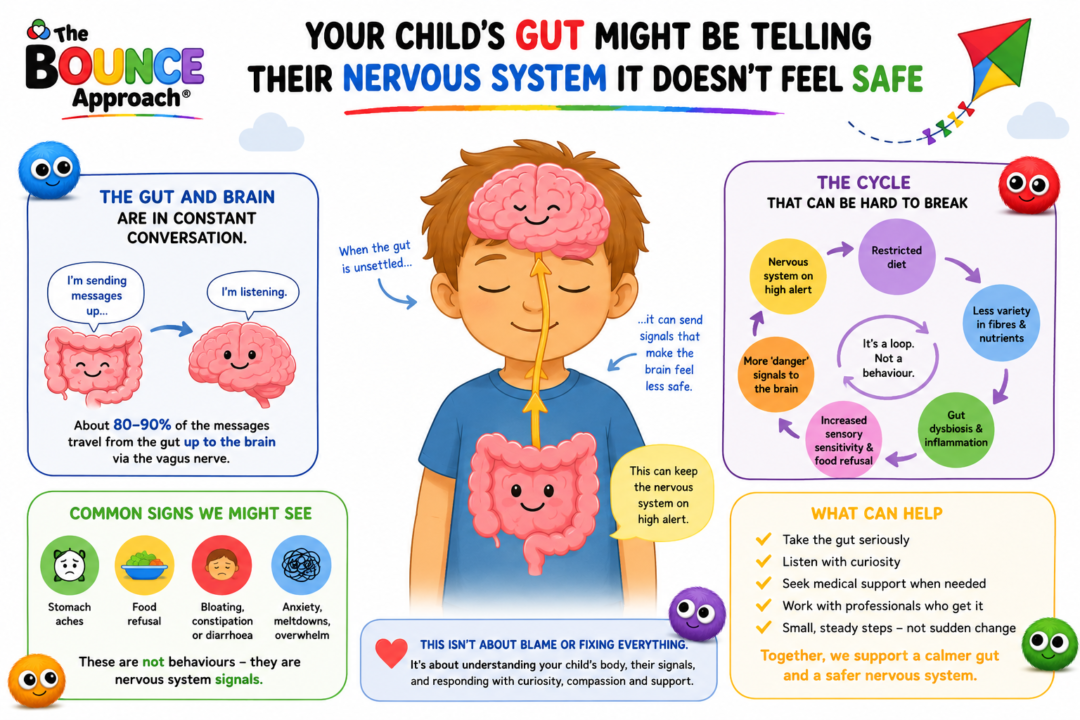
And here is the part that changes everything: around 80–90% of the messages travelling along that nerve go from the gut up to the brain – not the other way around.
The gut is not waiting for instructions. It is sending them.
What it is sending, moment to moment, is information about whether the body feels safe or not. And the brain listens.
When the gut says “danger”, the whole nervous system hears it
If you’ve spent time with the BOUNCE Approach®, you’ll know that children’s behaviour is always coming from their nervous system.
When a child shuts down, melts down, refuses, or freezes, that is not a choice – it is a nervous system telling us that something doesn’t feel safe.
What we are now understanding through research is that the gut appears to be one of the nervous system’s most influential sources of information.
When the gut is inflamed, unsettled, or uncomfortable, it may send signals upward that contribute to the brain interpreting the body as less safe. And a nervous system receiving those signals may stay on alert:
Harder to settle
Harder to regulate
More reactive to the world outside
More vulnerable to overwhelm
Because it is already managing something difficult on the inside.
This matters enormously for children who already find regulation hard.
Some of what we see as emotional dysregulation – meltdowns, anxiety, overwhelm, irritability – may have a physical gut component that nobody has named.
Why neurodivergent children are particularly affected
Research consistently shows that autistic children and children with ADHD are significantly more likely to experience gut difficulties than neurotypical children.
Studies suggest that between half and four-fifths of autistic children experience digestive symptoms such as:
ConstipationStomach painBloatingDiarrhoeaDigestive discomfort
For a long time, this was treated as a coincidence. The research doesn’t support that separation anymore.
Research has identified differences in the gut microbiome in many autistic children and some children with ADHD, although researchers are still exploring exactly what these differences mean.
The gut microbiome is the community of billions of tiny organisms that live in the digestive system, and it plays an important role in health, including brain health and mood.
This does not mean gut health causes neurodivergence. It does not mean that treating the gut will change who a child is. That is not the point.
The point is that many neurodivergent children are living with significant physical discomfort that may be contributing to their nervous system remaining on high alert.
And that has often been missed, minimised, or placed in the “not our department” box for far too long.
The food refusal piece – and why it makes complete sense
Let’s talk about food. Because this is where so many parents feel the most stuck, the most judged, and the most exhausted.
Many neurodivergent children eat from a very small list of safe foods. The list often has very specific rules:
Certain brands only
Certain textures only
Certain colours only
Served in a particular way
Changing anything, even slightly, can result in genuine distress.
From the outside this can look like stubbornness or anxiety about eating. From the nervous system’s perspective, it makes complete sense.
Food is an intensely sensory experience.
TextureTemperatureSmellColourMouth feelMemory
All of these are processed by a nervous system that may already be working extremely hard.
For a child whose sensory system is set to high sensitivity, a new food is not a mild inconvenience. It can be genuinely overwhelming.
The gagging is real.
The distress is real.
The body’s response is real.
Even if what is on the plate looks completely ordinary to everyone else. So, the nervous system learns:
“These foods are safe. These foods are not.”
And because its job is protection, it holds that knowledge tightly.
The cycle that nobody explains
The difficulty is that a very restricted diet often means less variety in the fibres and nutrients that help support a healthy gut microbiome.
1
A very restricted diet
2
Less variety in the fibres and nutrients that support the gut
3
Gut dysbiosis
4
More unsettled signals upward to the brain
5
The nervous system stays on alert
6
Sensory sensitivity around food increases
7
Trying new foods feels even harder
And back to the start
It is a loop. And understanding that it is a loop – rather than a behaviour to be managed – changes how we respond.
There is one more layer worth naming. Some neurodivergent children find it genuinely difficult to interpret signals coming from inside their bodies – a process known as interoception.
They may not notice hunger, fullness, nausea, or digestive discomfort until those sensations become very intense.
What looks like a sudden emotional reaction may sometimes be a body signal that has been building quietly for some time.
This is not a child being dramatic. It is a nervous system doing its best with information that isn’t easy to read.
What does this mean in practice?
It doesn’t mean overhauling your child’s diet overnight. It doesn’t mean introducing a long list of new interventions.
The nervous system doesn’t respond well to sudden change. Neither does a child who already has a difficult relationship with food. It means:
Taking the gut seriously as part of your child’s wellbeing picture.
Listening with curiosity when physical symptoms show up.
Recognising that stomach aches and digestive difficulties may be meaningful information.
Seeking appropriate medical support when symptoms are persistent or severe.
A nervous system lens does not replace medical care. It sits alongside it.
If your child is experiencing significant gut symptoms, speak to your GP and ask for support.
A paediatric dietitian who understands neurodivergent eating patterns, or an occupational therapist who works with sensory feeding differences, may be particularly helpful.
One thing to try today
If your child complains of a stomach-ache and it’s not clear why, try responding with curiosity rather than solving. You might say:
Try saying
“Your tummy’s telling us something – I wonder what it needs right now?”
This keeps the body’s signals in the conversation as valid and meaningful information, rather than something to be dismissed or fixed.
Over time, this kind of language helps children build awareness of what their body is saying. And that awareness is one of the most powerful regulation tools there is.
The goal is not a perfect gut, a perfect diet, or perfect eating habits. The goal is understanding.
When we begin to see stomach aches, food refusal, and digestive difficulties as information rather than defiance, we can respond with greater curiosity, compassion, and support.
And that shift – from managing behaviour to understanding a body that is doing its best – is exactly where the BOUNCE Approach® begins.
References
Gershon, M.D. (1998). The Second Brain: The Scientific Basis of Gut Instinct. HarperCollins.The foundational source on the enteric nervous system and gut-brain communication.Open sourceCryan, J.F., & Dinan, T.G. (2012). Mind-altering microorganisms: the impact of the gut microbiota on brain and behaviour. Nature Reviews Neuroscience, 13(10), 701–712.The landmark paper on the microbiome-gut-brain axis and its implications for mood and regulation.Open sourceMcElhanon, B.O., McCracken, C., Karpen, S., & Sharp, W.G. (2014). Gastrointestinal symptoms in autism spectrum disorder: a meta-analysis. Pediatrics, 133(5), 872–883.The meta-analysis behind the prevalence figures for GI symptoms in autistic children.Open sourceGarfinkel, S.N., Seth, A.K., Barrett, A.B., Suzuki, K., & Critchley, H.D. (2015). Knowing your own heart: distinguishing interoceptive accuracy from interoceptive awareness. Biological Psychology, 104, 65–74.The key interoception research underpinning the section on reading internal body signals.Open sourcePorges, S.W. (2011). The Polyvagal Theory: Neurophysiological Foundations of Emotions, Attachment, Communication, and Self-Regulation. W.W. Norton.The theoretical framework connecting nervous system state, felt safety, and the gut-brain relationship throughout the article.Open source