Why Schools Need a Neurodevelopmental Approach
What the Latest EHCP Data Tells Us – and How the BOUNCE® Framework Responds
Although Government statistics refer to Autistic Spectrum Disorder (ASD) as a primary EHCP category, we take a neurodivergent-affirming approach.
Throughout this post, we refer to it as autism, because autism is a neurotype – not a disorder.
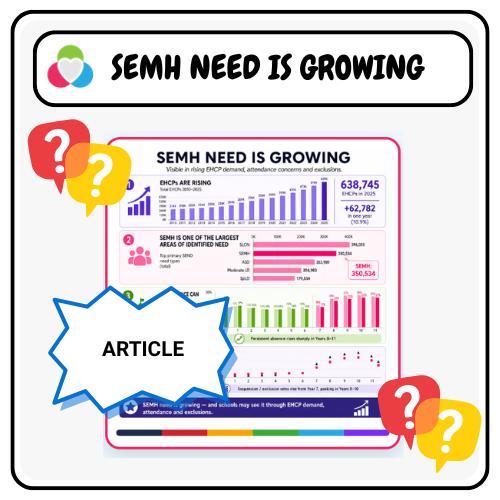
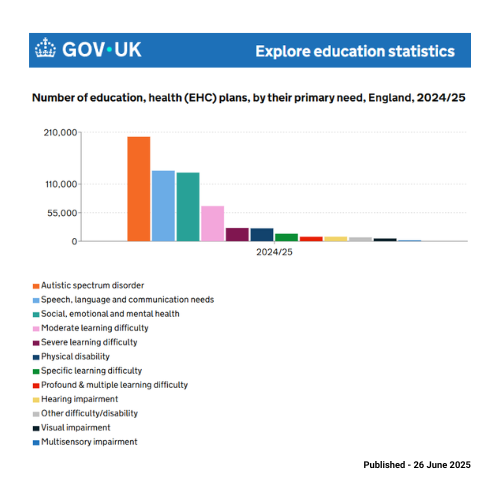
The latest Government data (June 2025) highlights what schools experience every day:
the majority of EHCPs now relate to neurodevelopmental needs.
- Autism is the largest primary need.
- Speech, Language & Communication Needs follow.
- SEMH continues to rise.
- Sensory and physical needs shape how students cope and engage in school.
These needs stem from emotional overload, distress, uncertainty, sensory vulnerability and communication differences – not choice.
This is why schools need a neurodevelopmental framework that takes a preventative, proactive stance, supporting students before overwhelm develops.
The BOUNCE® Approach was designed specifically for this landscape.
📈 The Data Shows Neurodevelopmental Need – Not Students “Choosing” to Struggle (A Regulation, Trauma-informed Lens)
The 2024/25 EHCP statistics show the highest areas of identified need are:
🔵 Autism
🟦 Speech, Language & Communication Needs
🟧 Social, Emotional & Mental Health
🔷 Sensory & Physical Needs
All of these need types relate directly to regulation – how the nervous system manages emotional, sensory, cognitive and relational input.
When regulation capacity is exceeded, students may:
- become activated, high energy, or overwhelmed
- withdraw, disconnect or shut down
- experience difficulty organising thoughts
- lose access to language
- become distressed by transitions
- feel overwhelmed by noise, movement or unpredictability
- mask until their internal energy is depleted
These are automatic nervous system responses, not conscious choices.
A regulation lens shifts the focus from “Why are they doing this?”
to “What is overwhelming them, and what support do they need to feel safe again?”
Through this lens, emotional signals become meaningful:
- activation = “My system is struggling.”
- withdrawal = “I’m overloaded.”
- stillness/freeze = “I don’t feel safe enough to act or speak.”
- silence = “I can’t access my words right now.”
- intensity = “My body is trying to stabilise itself.”
When schools prioritise co-regulation, predictable routines, sensory adjustments, relational attunement and emotional safety, students regain capacity for connection and learning.
This is the foundation of the BOUNCE® framework.
🧠 Why the BOUNCE® Framework Aligns With EHCP Need
BOUNCE® is a trauma-informed, neurodivergent-affirming, neurodevelopmental framework, grounded in the way students develop emotionally, relationally, and neurologically.
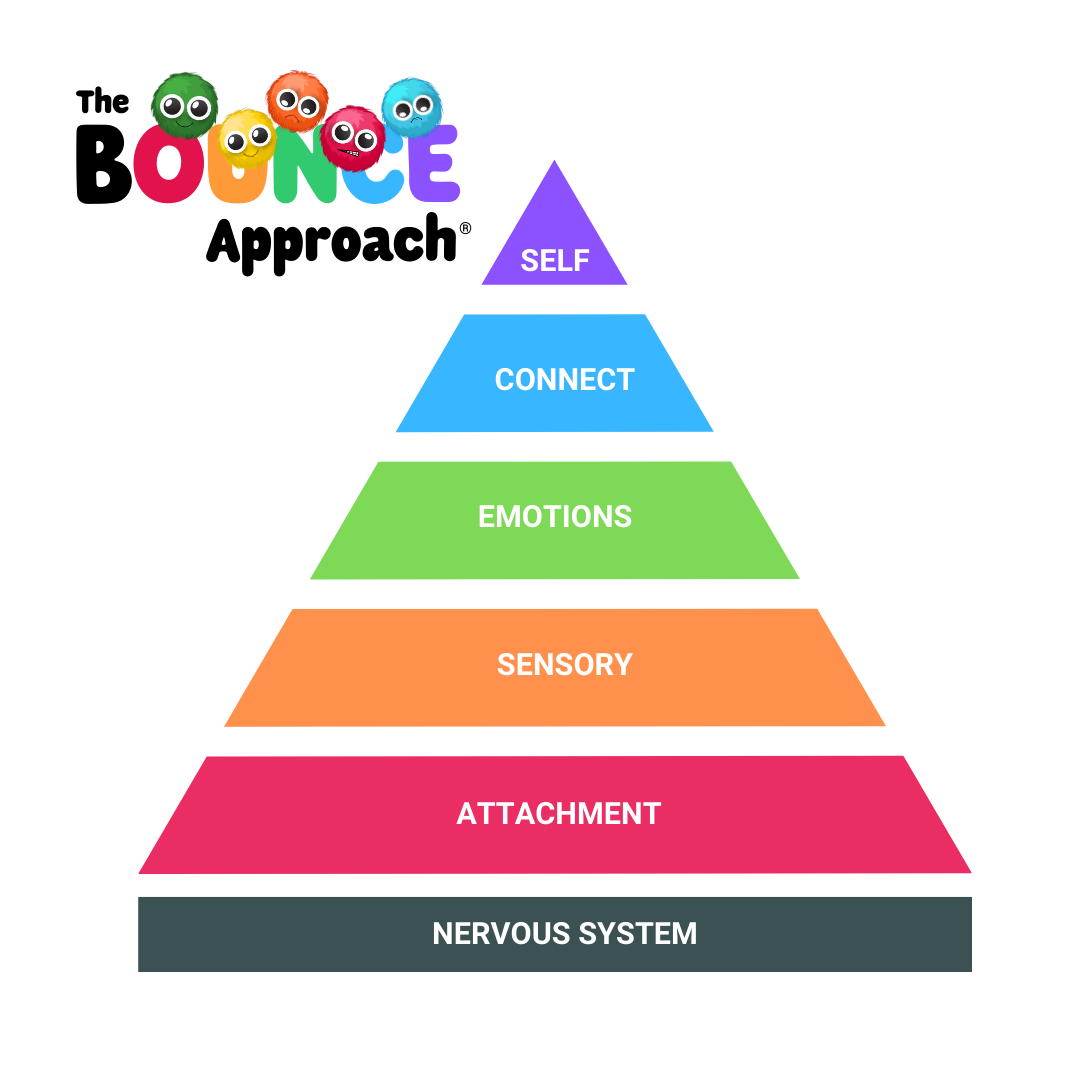
It strengthens six interconnected developmental tiers:
- B: ody & Nervous System
- O: penness to Connection/Attachment
- U: nderstanding Sensory Differences
- N: avigating Emotions
- C: onnection to Self & Others
- E: steem & Identity
Below is the complete breakdown – including every training with the EHCP strand it aligns to.
🔵 B – Body & Nervous System (Regulation Foundations)
For students experiencing overwhelm, shutdown, panic or difficulty regulating.
Training (EHCP Strand):
- Expanding the Window of Tolerance (SEMH)
- Emotional Regulation & BOUNCE® (SEMH)
- Grounding & Somatic/Reset Techniques (SEMH)
- Co-regulation & De-escalation (SEMH)
- Drumming for Regulation (SEMH + Sensory & Physical)
- Sensory Circuits (Sensory & Physical)
- Interoception in the Classroom (Sensory & Physical)
- Soft Landings – Transitions (SEMH)
Supports students who:
- shift into fight/flight/freeze
- feel overwhelmed by unpredictability
- experience EBSA
- mask and emotionally collapse later
- find group settings difficult
🩵 O – Openness to Connection/Attachment (Relational Safety)
For students who need emotional safety and predictability to engage.
Training (EHCP Strand):
- Attachment Through Play (SEMH)
- Different Presentation Home vs School (SEMH)
- Trauma-Informed Practice (SEMH)
- PACE (SEMH)
- Restorative Approaches (SEMH + C&I)
- Solution Circles (SEMH + C&I)
- BOUNCE® @ School (Whole-setting SEMH)
Supports students who:
- appear withdrawn
- feel safer with a familiar adult
- mask throughout the day
- struggle with relational trust
- find reconnection difficult
🔷 U – Understanding Sensory Differences (Sensory & Physical)
For students experiencing sensory overload, shutdown, or interoceptive uncertainty.
Training (EHCP Strand):
- Sensory Circuits (Sensory & Physical)
- Multi-Sensory Regulation Toolkit (Sensory & Physical)
- Fidget & Focus Tools (Sensory & Physical)
- Sensory Overload & Emotional Overwhelm (Sensory & Physical + SEMH)
- Sensory Story Massage (Sensory & Physical)
- Interoception in the Classroom (Sensory & Physical)
Supports students who:
- feel overwhelmed by noise, movement or bright spaces
- misread internal cues
- mask sensory distress until they crash
- rely on movement to regulate
- freeze or shut down when overloaded
🟧 N – Navigating Emotions (SEMH + Communication & Interaction)
For students who need accessible ways to make sense of emotions.
Training (EHCP Strand):
- Lego Feelings (SEMH + C&I)
- Play-Doh Feelings (SEMH + C&I)
- Drawing Feelings (SEMH)
- Creative & Expressive Arts (SEMH)
- Parts-Based Approach (SEMH)
- Reducing Anxiety (SEMH)
- Managing Demand Avoidance (SEMH + C&L)
- Emotional Intelligence (SEMH)
- Mindful Awareness (SEMH)
Supports students who:
- struggle to express feelings verbally
- withdraw under emotional pressure
- feel distressed by uncertainty
- mask emotional needs
- freeze when overwhelmed
🟦 C – Connection to Self & Others (Communication & Interaction + Cognition & Learning)
For students developing communication, social understanding and executive functioning.
Training (EHCP Strand):
- Theory of Mind (C&I)
- Comic Strip Intervention (C&I)
- Supporting Autistic Students (C&I + C&L)
- Declarative Language (C&I)
- Executive Function & Thinking Skills (C&L)
- EBSA Support (SEMH)
- Secondary Transition (SEMH)
Supports students who:
- feel socially unsure
- experience selective mutism or social anxiety
- misread cues
- communicate differently
- struggle with memory or organisation
💛 E – Esteem & Identity (SEMH)
For students developing confidence, belonging and identity-safety.
Training (EHCP Strand):
- Tree of Life Intervention (SEMH)
- Strengths & Identity-Based Activities (SEMH)
- BOUNCE® Practitioner Programme (All Strands)
- Reflection & Self-Development Tools (SEMH)
Supports students who:
- doubt their abilities
- avoid challenge due to fear
- mask heavily
- feel different or misunderstood
- need identity support and belonging
🌱 Meeting Needs Changes Life Chances
When a student’s needs are understood and met through the right developmental support – sensory, emotional, relational, communication or identity-based – everything changes.
Students feel safer.
Students engage more.
Students learn.
Students stay in education.
Students trust.
Students grow.
A proactive, neurodevelopmental approach doesn’t just support day-to-day coping – it changes life chances.
When needs are met early and effectively, students:
- attend more consistently
- cope better with transitions
- build relationships
- understand their emotions
- develop strengths and aspirations
- build confidence and identity
Meeting needs isn’t just intervention.
It is prevention, protection and long-term impact.
And when needs are met early, the level of support required over time often reduces – because distress stops escalating into crisis.
This is the true power of The BOUNCE® Approach.
🏫 Why Teams, Settings, Schools, and Colleges Choose the Learning Portal
Individual courses can be purchased on demand.
However, the Learning Portal Membership offers the strongest impact because it provides:
💙 Full access to every BOUNCE® course
💙 All interventions and downloadable toolkits
💙 Unlimited CPD for all staff
💙 A free CPD Mapping Session
💙 A shared, emotionally-aware approach across your setting
💙 Free access for Parents and Carers
This session alone saves settings hours of planning time and adds clarity, consistency and confidence to provision mapping.