A Neurodevelopmental Framework for Emotional Wellbeing
How do you support a child or young person who flips between fizzy and flat before lunchtime?
How do you reach someone who lashes out, shuts down, or masks – not because they’re being difficult, but because their nervous system is overwhelmed?
The BOUNCE Approach® was created for children and young people like these.
I’m Tracy Chadwick, founder of Child Therapy Service CIC.
After years working in SEMH education, expressive arts therapies, and somatic practice, I became determined to understand what truly lies beneath behaviour.
Because what we call “challenging behaviour” is so often misunderstood.
It’s not defiance – it’s communication.
A nervous system saying, “I don’t feel safe.”
Until we meet that need at its root, the behaviours persist – and young people are left feeling punished, disconnected, and emotionally alone.
That’s why I developed the BOUNCE Approach® – a neurodevelopmental, trauma-informed, and neuro-affirming framework that helps children and young people regulate from the inside out.
🧠 What Is The BOUNCE Approach®?
The BOUNCE Approach® is a whole-child, whole-system model that helps children and young people make sense of what’s happening inside their body and mind — and rebuild safety from the ground up.
It begins with identifying the underlying need beneath behaviour and meeting that need through a neurosequential developmental framework.
Rather than managing surface behaviours, the focus is on supporting the parts of the brain and body that must feel safe before learning, reasoning, or social engagement can happen.
Through this lens, children and young people learn to:
- Understand what’s happening inside their body
- Recognise sensory and emotional states without shame
- Stay open to connection – with others and with themselves
- Build trust, confidence, and a felt sense of belonging
The BOUNCE Approach® integrates polyvagal theory, the window of tolerance, IFS (Internal Family Systems), sensory integration, and neurosequential development into one coherent framework – turning complex neuroscience into everyday, practical tools that educators, families, and practitioners can use to support regulation and resilience.
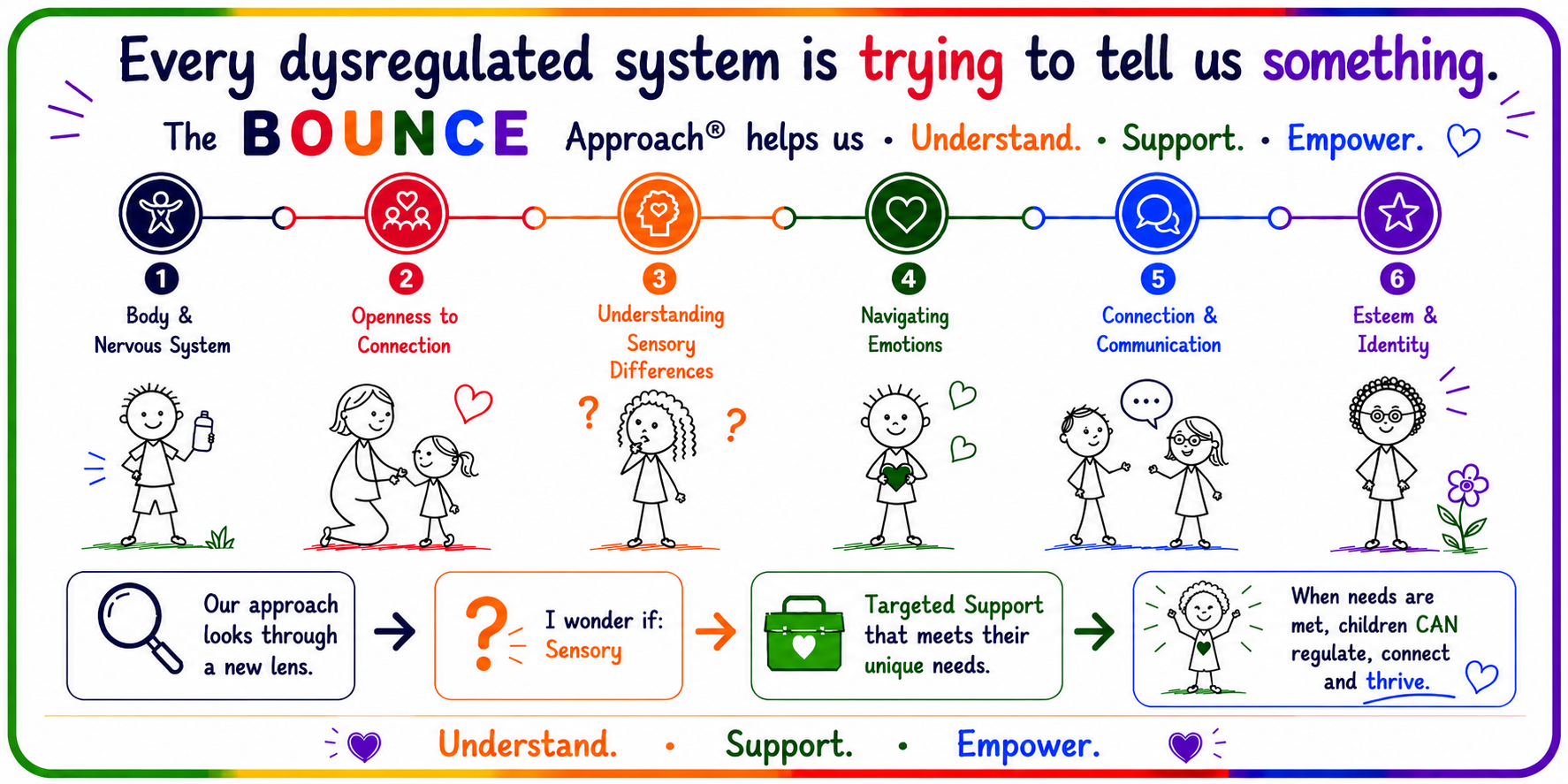
What Does BOUNCE® Stand For?
| Letter | Domain | Description |
| B | Body (Nervous System Awareness) | Recognising internal states using the three-part brain and polyvagal theory. Feeling comes before thinking – safety comes before learning. |
| O | Openness to Attachment | Creating consistent, non-pressured relational safety and helping young people connect to their inner parts with curiosity, calm, and compassion (IFS principles). |
| U | Understanding Sensory Differences | Respecting sensory profiles, interoception, and energy limits using spoons theory. Sensory support is a condition for wellbeing – not an add-on. |
| N | Navigating Emotions | Building emotional literacy through metaphor, movement, rhythm, and pacing. Emotions are expressed – not managed. |
| C | Connection to Self and Others | Supporting authentic relating – both socially and internally. We create safe conditions for connection. |
| E | Esteem and Identity | Fostering belonging, agency, and internal safety. Children and young people don’t build self-esteem through praise – they build it through feeling safe and seen as they are. |
💡 What Changes With The BOUNCE Approach®?
The BOUNCE Approach® changes how adults understand and respond to children and young people in distress.
It replaces reactive, behaviour-focused strategies with calm, informed, nervous-system-led support.
Using a structured baseline and progress framework, practitioners identify the underlying developmental needs beneath behaviour and respond in the right order – following a neurosequential model of growth and regulation.
Safety and connection come first, before reasoning or reflection.
The result is measurable progress in the areas that matter most:
- Children and young people begin to recognise what’s happening in their own body
- Adults respond to stress behaviours with precision and empathy
- Relationships shift from control to trust
- Environments become calmer, more predictable, and genuinely inclusive
Professionals using the BOUNCE® framework consistently report greater clarity, fewer crisis cycles, and stronger co-regulation between adults and young people.
But the most powerful change is internal:
children and young people start to understand themselves – not as “difficult,” but as capable of calming, connecting, and re-engaging with confidence.
🌍 Who Is The BOUNCE Approach® For?
The BOUNCE Approach® is being embedded across:
- Mainstream and SEMH specialist settings
- Nurseries and early years environments
- Therapeutic and paediatric health teams
- Social care and residential services
- Youth and college transition programmes
It supports children and young people who are:
- Neurodivergent
- Demand avoidant or experiencing school-based anxiety and non-attendance
- Sensory-sensitive and easily overwhelmed by noise, light, or unpredictability
- Trauma-impacted or emotionally overloaded by daily stressors
- Prone to shutdown, masking, or explosive dysregulation
At the heart of all these presentations is the same truth: a dysregulated nervous system doing its best to protect itself from overwhelm.
When we see behaviour through that lens, everything changes.
We stop asking “What’s wrong?” and start asking “What happened to you – and what does your nervous system need right now?”
💬 Why It Matters
The BOUNCE Approach® gives children and young people – and the adults supporting them – the tools to listen to the body, connect with compassion, and build regulation from the inside out.
Every child and young person deserves to feel safe, connected, and understood.
That’s what this is all about.
That’s what we stand for.
🚀 Next Steps
The best way to understand the BOUNCE Approach® is to experience it.
Our membership and training options give you access to the tools, courses, and frameworks that bring it to life in real settings.
1. Join the Learning Portal
Access 50+ specialist trainings, printable tools, and structured interventions – all aligned with the BOUNCE® pillars.
Members gain access to exclusive regulation frameworks, baseline tools, and progress tracking resources designed to evidence change over time.
Join the Portal →
2. Train to Become a BOUNCE® Practitioner
Learn how to apply the BOUNCE® principles confidently in your own practice.
Practitioner training combines theory, reflection, and real-world application – helping you embed a nervous system lens into everything you do.
Explore Practitioner Training →
3. Become a BOUNCE® Setting
Show your commitment to neuro-affirming, trauma-informed practice.
Recognised BOUNCE® settings receive a verification badge and access to exclusive supervision and updates.
Why not access this free webinar to learn more
✨ Final Thought
The BOUNCE® Approach isn’t a behaviour policy or a set of strategies – it’s a shift in understanding.
When we stop managing behaviour and start supporting nervous systems, children and young people don’t just cope better – they begin to thrive.