BOUNCE Approach®Co-RegulationCPD CertifiedOn-DemandND-Affirming
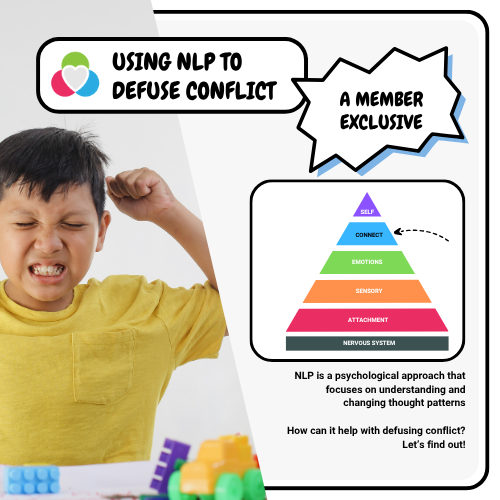
Using NLP to De-escalate and Defuse Conflict
Explore how Neuro-Linguistic Programming and the PACE model work together to transform moments of conflict and emotional outburst into genuine opportunities for connection and co-regulation.
NLP offers a powerful lens for understanding how a child’s internal world shapes their behaviour — and how the language, tone, and presence of the adult in the room can either escalate or defuse what’s happening. Combined with the PACE model developed by Dr Dan Hughes, this training builds a practical communication framework grounded in attunement, curiosity, and genuine connection.
Through real case study examples including ‘Sid’, you’ll explore how to apply NLP and PACE in everyday situations — responding to emotional outbursts, reducing stress in the moment, and using the way you communicate to support regulation rather than inflame it. Suitable for anyone working directly with children who experience conflict, dysregulation, or emotional escalation.
Objectives
Learning Objectives
By the end of this training, you will be able to:
1
Understand separation anxiety and the anxiety cycle
Explore the purpose of separation anxiety as a nervous system protective response — and understand how the anxiety cycle develops, reinforces itself, and shapes a child’s behaviour over time.
2
Explain what NLP is and how it applies to supporting children
Gain a clear understanding of Neuro-Linguistic Programming — what it is, how it works, and why its insights into communication, language, and internal experience are relevant to working with children in distress.
3
Understand why a child’s inner world matters
Explore why understanding a child’s internal experience — their beliefs, perceptions, and felt sense of the world — is the essential starting point for any adult who wants to support rather than simply manage them.
4
Explain the connection between communication and anger
Understand how communicative breakdown — being misheard, misread, or unable to express what is happening inside — drives anger and dysregulation in children, and why addressing communication is central to reducing it.
5
Understand how our internal world shapes our behaviour
Explore how a child’s internal representations, beliefs, and nervous system state directly determine how they behave — and why changing the behaviour without addressing the inner world rarely works.
6
Apply learning through a case study — meet Sid
Explore a real-world case study to see how separation anxiety, communication difficulties, and internal world dynamics interact — and what effective support actually looks like in practice.
7
De-escalate using attunement
Understand how attuning to a child’s emotional and nervous system state — rather than reacting to their behaviour — creates the conditions for de-escalation and genuine connection in moments of distress.
8
De-escalate using PACE
Apply Playfulness, Acceptance, Curiosity, and Empathy as a de-escalation stance — understanding how each element of PACE shifts the relational dynamic and supports the child’s nervous system back toward safety.
9
De-escalate using matched communication styles
Learn how to match your communication style to the child’s processing modality — visual, kinaesthetic, auditory, or gestalt — so your words and tone land in a way the nervous system can actually receive during moments of overwhelm.