
Therapeutic LEGO® Activity Pack
Building gives a feeling somewhere to go without words. A child or young person can show what is happening inside using colour, shape, size and story, and does not need to explain it for it to matter.

What it is
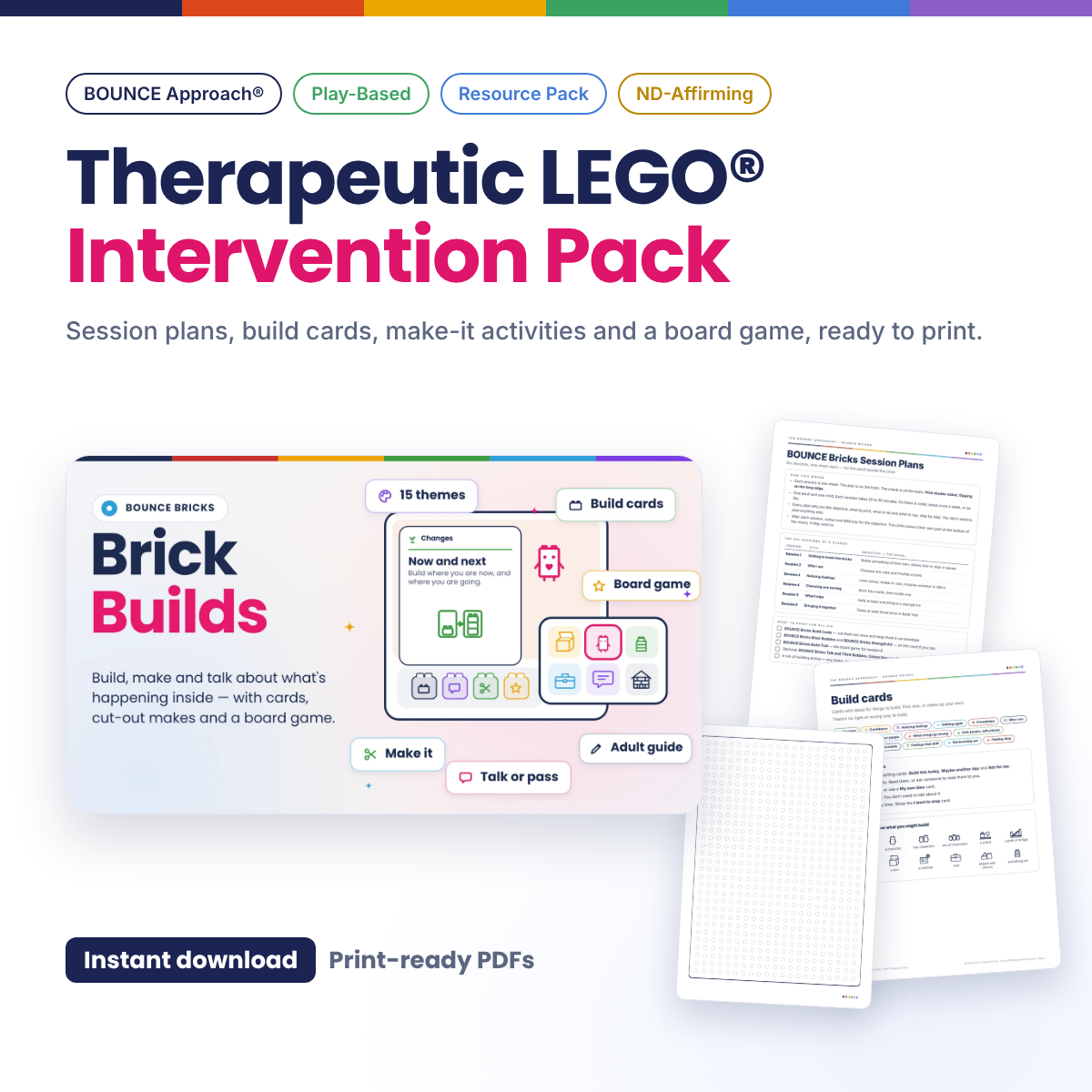
Six short sessions with one child or young person and one adult. Each session has one clear objective. The child builds from picture cards, makes something to keep, and ends with a board game.
- Talking is always optional
- They can stop at any time, without saying why
- Not therapy, a teaching programme or a behaviour tool
- Nothing is decoded, scored or compared
How it helps
For the child or young person“I can show it without having to say it.”
For the adults“I can notice without needing to fix it.”
- A character or a scene can hold a feeling that is too big to say as “me”.
- Cards with pictures, and cards for saying something without words, give every child a way in.
- The make-it activities and board game give the child something to hold, colour, keep or play.
How to get started

Print the session plans
Each sheet is one session: the plan on the front, a quick check on the back. Print double-sided.

Read the adult guide
Read it once, before session 1. How to be alongside the child, and a page for each of the fifteen themes.
Get ready for session 1
- Print the Build cards (session 1 below) and cut them out.
- Print at 100% (actual size), in colour or black and white.
- Find 20 to 30 minutes with one child or young person, at a settled time.
- Sit alongside them, not opposite.
You will need a tub of building bricks — any make, any amount — and scissors.
The six sessions
Each session has one objective, and the session plan tells you what to do. The adult ticks Met, Partly met or Not yet. The child colours their own part.

Getting to know the bricks
The child builds something of their own, and shows how they would stop or have a break.

Who I am
The child chooses a card and finishes a build, adding a brick buddy if they want.

Noticing feelings
The child uses colour, shape or size, and chooses whether to give the build a title.
Choosing and sorting
The child sorts four cards with the sorting cards, then builds one.

What helps
The child adds at least one thing to a strength kit: a build, a drawing or a word.

Bringing it together
The child takes turns in the Build Trail board game, then a free build to finish.
More to make
Optional extras. Each one starts empty, and what the child makes belongs to them.

Build dice
A fold-up dice with six build ideas, and a blank one to fill in.

Keeping box
A small fold-up box with a lid. The child decides what it is for.

Colour key
Bricks to colour, with a line for what each colour means to the child.

Paper bricks
Bricks to colour, cut and lay out. A quiet option.

Build mats
A plate, a two-part mat, and two places joined by a path.

Build book
A one-sheet folded book, with fold steps.
Before you print
- Print at 100% (actual size), in colour or black and white.
- Dashed lines are for cutting, dotted lines for folding, grey tabs for glue.
- You can cut out fiddly parts in advance.
While they build
- Stay calm, quiet and present.
- Wonder aloud only if the child invites you in.
- Never name a feeling for the child.
The build belongs to the child
- They decide whether it stays, is taken apart or is tidied away.
- Only take a photo if they want one, and agree who sees it.