

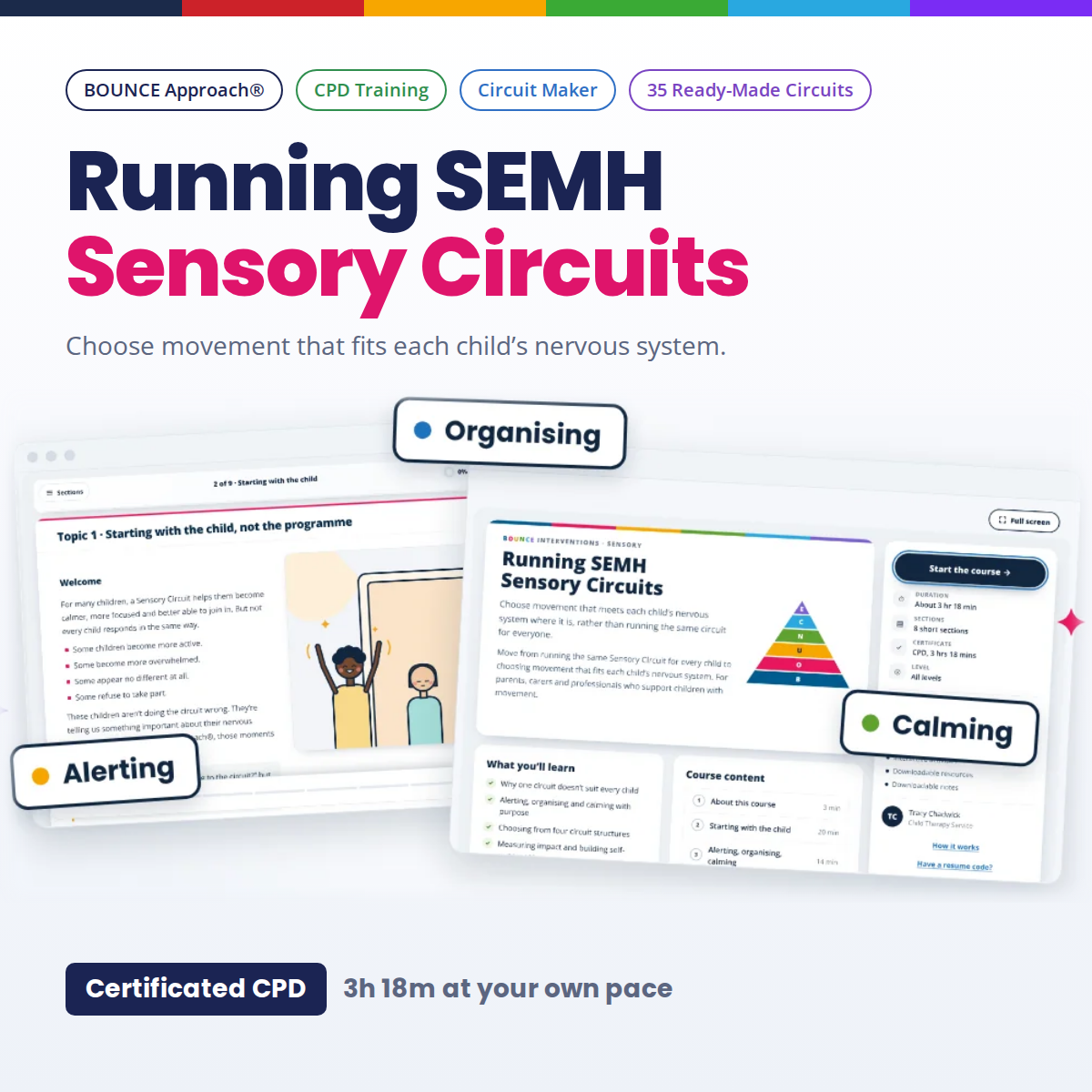
Running SEMH Sensory Circuits
Move from running the same Sensory Circuit for every child to choosing movement that fits each child’s nervous system.
For parents, carers and professionals who support children with movement. All levels, 3 hours 18 minutes at your own pace, in the Body and the Nervous System pillar of The BOUNCE Approach®.
Included in annual membership. Members can start it now in the Learning Portal. Go to my courses

What you’ll learn
No previous knowledge needed. The course starts from the beginning.
- Why one circuit doesn’t suit every child
- Movement as a way of communicating
- Alerting, organising and calming movement
- Choosing between four circuit shapes
- What to watch for, and when to adapt or stop
- Making your own circuit cards
- Helping children notice what helps them
- Parents and carers
- Teachers and TAs
- SENCOs and pastoral staff
- Therapists and youth workers

Inside the course
Video, reading and activities. Pause and come back any time.
- About this course3 min
- Starting with the child20 min
- Alerting, organising, calming14 min
- Watch the training100 min
- Choosing the right circuit16 min
- Your cards and the circuit maker25 min
- Putting it into practice12 min
- Check your understanding8 min
- Your CPD certificate

Make your own sensory circuit
The circuit maker is included. Build a circuit with the child, then print it as cards.
- 1Pick a shapeTriangle, Square, Pentagon or Hexagon, or start from what you notice.
- 2Choose the movements66 movements to choose from, or add the child’s own.
- 3Download the cardsAn A4 PDF to print and cut out, with words for ages 4 to 18.

Everything you need for a sensory circuit
Print, cut out and use again and again.
9 circuits
Organise, organise, calm.
10 circuits
Organise three times, then calm.
10 circuits
One alerting, two organising, then calm.
6 circuits
One alerting, three organising, then calm.
- Ages 4–6
- Ages 7–11
- Ages 12–15
- Ages 16–18
- Words-only cards

- Sensory Circuits quick guideRead this first: how to run the cards, and when to stop
- Choosing a shapeWhat makes each shape different, and when you might reach for it
- Creating your own circuitActivity ideas, movement breaks and a My circuit planner
- Assessment and TrackerAn optional observation tool for exploring sensory patterns (Excel)
What learners say
“Easy to follow, not too overwhelming, and a bank of resources to use without any specialist equipment. Fantastic.”Kellie
“It made me aware of how to change my existing approach of sensory circuits to provide the optimum benefit for individual children.”Helen
“Very informative and gives clear guidance of where to start.”Clare
Annual members already have this training. Log in to the Learning Portal to start it straight away, with nothing extra to buy.