
How I Communicate
Animal cards that help a child find how they take things in and share, and see it as a strength.
Free for members. Monthly and Annual members already have this pack. You’ll find it in the Learning Portal.

What it is
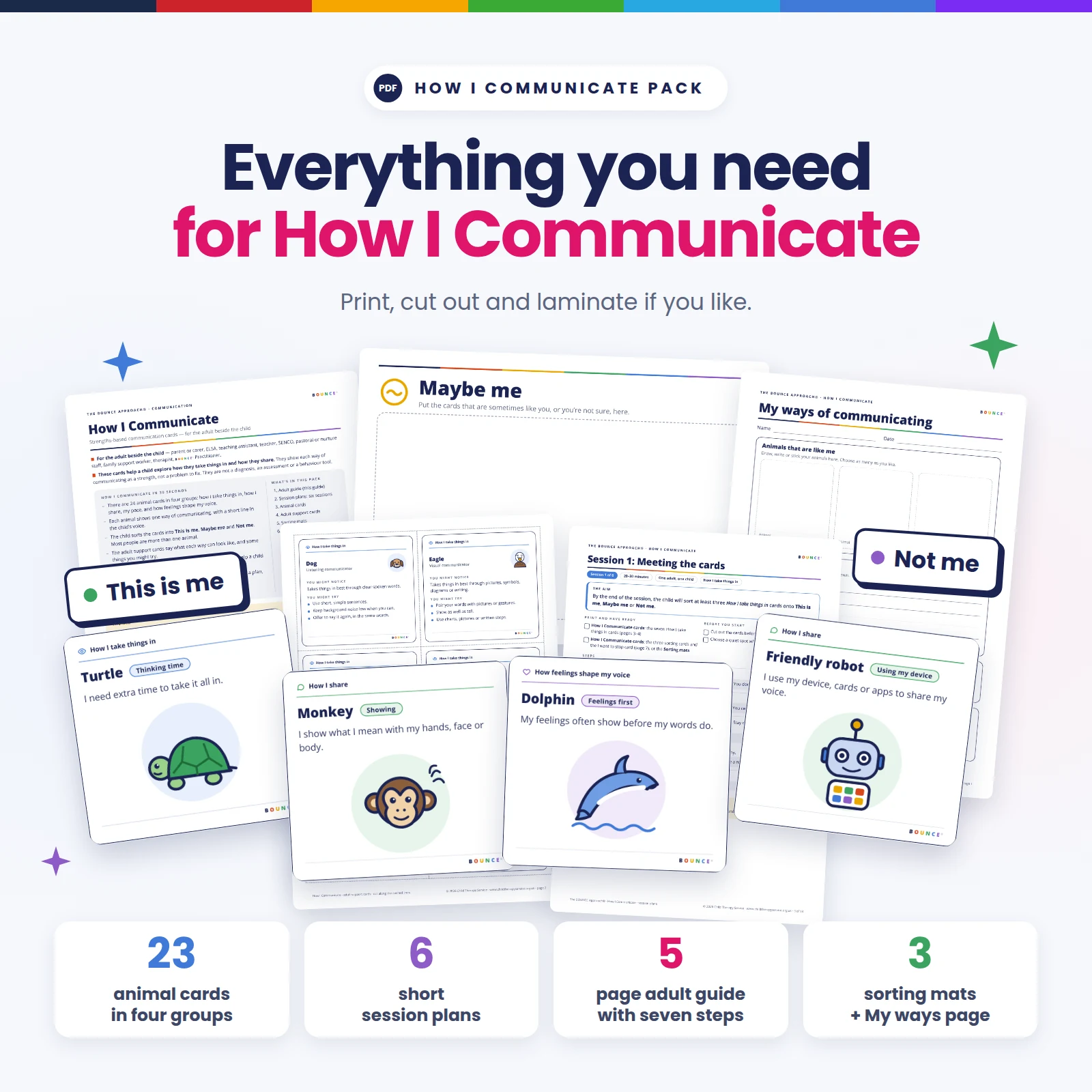
Strengths-based cards that help a child explore how they take things in and how they share. Each way of communicating is shown as a strength, not a problem to fix.
The child sorts the cards into This is me, Maybe me and Not me. Most people are more than one animal.
- 23 animal cards in four groups, plus a blank My own animal card
- An adult support card for every animal
- Six short session plans
- Three sorting mats
- The child’s own My ways of communicating page
For the adult beside the child: parent or carer, ELSA, teaching assistant, teacher, SENCO, pastoral or nurture staff, family support worker, therapist or BOUNCE Practitioner.
Three things to hold onto
Gestures, repeating, drawing, a device, a pause and silence are all real communication.
Your part is to notice and receive, not to decide which animal they are.
Maybe me and Not me tell you as much as This is me.
Four groups of animals
Each animal shows one way of communicating, with a short line in the child’s own voice.
- How I take things in7
I understand best when I can see it.
Eagle, Dog, Elephant, Ant, Deer, Turtle, Camel - How I share9
I show what I mean with my hands, face or body.
Monkey, Parrot, Friendly robot, Beaver, Fox, Panda, Horse, Owl, Goldfish - My pace3
I take my time to think before I speak.
Snail, Rabbit, Koala - How feelings shape my voice4
My feelings often show before my words do.
Dolphin, Swan, Robin, Chameleon
My own animal is a blank card. The child can draw any animal that shows how they communicate.
Six short sessions
Each takes 20 to 30 minutes, with one adult and one child. You can stop or skip any session. You don’t need to do all six.
- Meeting the cardsSorts at least three How I take things in cards
- How I shareSorts three How I share cards and chooses one
- My paceSorts the three My pace cards and chooses one idea for adults
- Feelings and my voiceChooses which feelings cards to look at and sorts them
- Making my pageAdds at least one animal to their page and chooses who sees it
- Other people’s waysChooses a card for someone else and suggests one way to work together
What you can print and keep
Six A4 PDFs. Print in colour or black and white, cut out, and laminate if you like.
- Adult guideFive pages: the cards at a glance, three ways in and seven steps you can take in any order
- Session plansSix sessions, each one sheet: the plan on the front, a simple check on the back
- Animal cards30 cards: 23 animals, My own animal, three sorting cards, two My own idea cards and an I want to stop card
- Adult support cardsWhat each way can look like and things you might try. Use on their own, or print on the back of the animal cards
- Sorting matsThree mats: This is me, Maybe me and Not me
- My ways of communicatingTwo pages: the child’s own page, and When we see things differently for two people to use together
Nothing is scored, and nothing is kept unless the child agrees. The cards are not a diagnosis, an assessment or a behaviour tool.
Need more than one? Membership is £319 a year.
It includes every intervention in the shop, every resource, and everything added through the year.