BOUNCE Approach®Whole-SchoolCPD CertifiedLive TrainingND-Affirming
BOUNCE @ School
A 3-hour foundational training that gives school staff the knowledge, tools, and framework to support children’s emotional and social wellbeing — and embed a whole-school approach to regulation.
This core training introduces The BOUNCE Approach® — an integrated, neurodevelopmental framework for supporting children’s emotional and social health in schools. You’ll explore how nervous system dysregulation affects learning, behaviour, and relationships, and why shifting from reactive responses to regulation-focused, needs-led support changes everything for children and staff alike.
Across the six core areas of BOUNCE — Body and Nervous System, Openness and Attachment, Understanding Sensory Differences, Navigating Emotions, Connection with Others, and Expression of Self — you’ll learn how to interpret behaviour through a nervous system lens, apply the framework to everyday planning and provision, and use your own regulated nervous system as the most powerful co-regulation tool available.
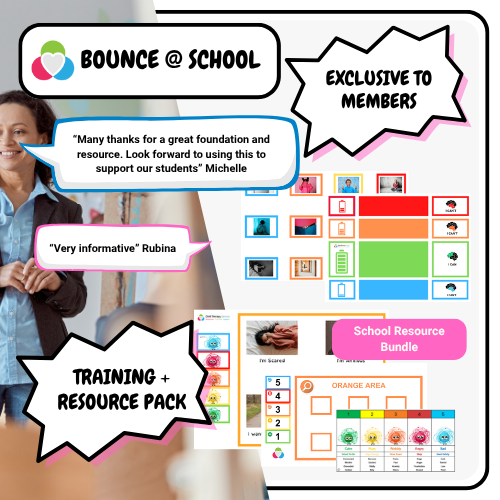
Designed for all school staff — from classroom teachers and teaching assistants to SENCOs and pastoral leads. This foundational training is delivered with practical tools, music, visuals, and strategies ready to use from day one, and provides the solid base needed for practitioner-level BOUNCE training.
Learning Objectives
Learning Objectives
By the end of this training, you will be able to:
1
Understand why some children resist experiences due to nervous system overwhelm
Recognise how overwhelm in the nervous system drives avoidance and resistance — and why this is a protective response, not a choice.
2
Attune to your own nervous system and the child’s
Develop awareness of your own physiological state and how it interacts with the child’s — because co-regulation begins with the adult.
3
Help children free up nervous system capacity for new experiences
Explore practical ways to reduce load and create the internal space a child needs before new learning or experience becomes possible.
4
Identify unmet needs with curiosity and compassion
Approach each child’s presentation with genuine curiosity — moving from judgement to understanding, and from behaviour management to need identification.
5
Read behaviour as an activated nervous system
Interpret what a child’s behaviour is communicating about their nervous system state — and begin to identify the regulation tools that will actually meet that need.
6
Understand how internal, external, and interpersonal factors affect the nervous system
Explain how changes in physiological state are triggered by factors inside the body, in the environment, and between people — and how each channel requires a different response.
7
Regulate the nervous system and expand capacity throughout the day
Understand why regulation is an ongoing, daily process — not a one-off intervention — and how to build regulatory support into the rhythm of a child’s day.
8
Activate the parasympathetic nervous system to build internal capacity
Recognise why parasympathetic activation is the foundation of a child’s ability to manage stressors — and how to create the conditions for it consistently.
9
Address a child’s needs sequentially using the BOUNCE framework
Apply the BOUNCE framework in developmental sequence — supporting the nervous system, attachment needs, sensory needs, emotional regulation, social connection, and sense of self in the order the nervous system can receive them.
10
Understand, meet, implement, and evaluate individual need
Follow the full cycle of support — understanding the child’s individual needs, meeting them through universal and targeted provision, implementing support, and evaluating progress over time.
11
Access strategies, tools, music, curriculum, and additional training
Leave with clear signposting to the resources, strategies, and next steps available to deepen your practice and continue the work beyond this training.